


Question
What is the sum of ages of F, T and C?
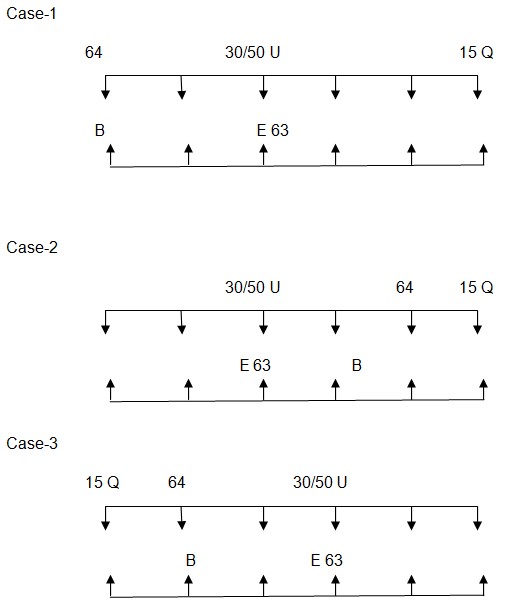
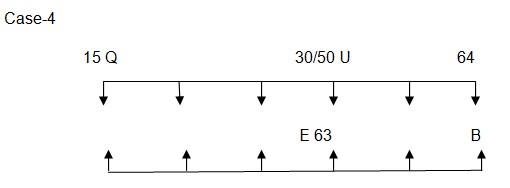 R’s age is multiple of 5 and S sits immediate left of R. S is not 64 years old. From this statement case 2 and Case 4 is eliminated.
 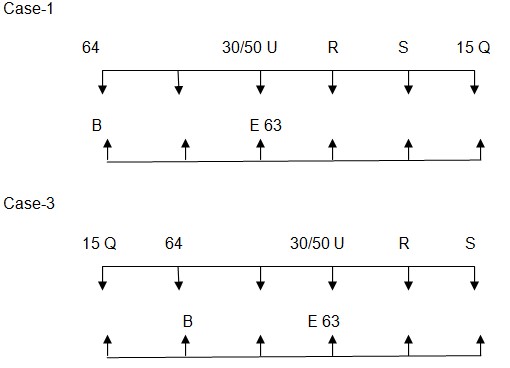 F sits somewhere to the left of B. From this statement case 1 is eliminated. A is 20 year younger than U and sits opposite to R. Form that A age is 30years and U age should be 50. P sits second to the left of the one who is opposite to F.
 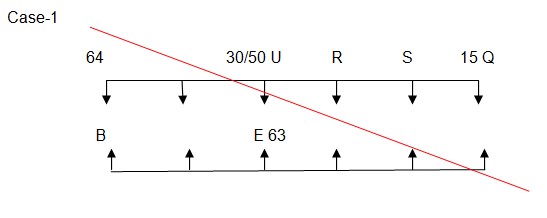 Incase1, F sits somewhere to the left of B, P sits second to the left of the one who is opposite to F, these conditions are not satisfied so rejected.
 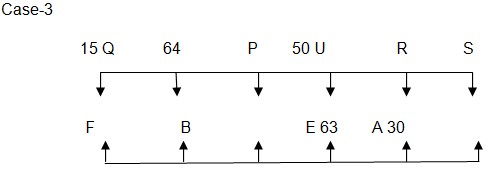 The number of person sits right of T is one less than that of number of person sits left of the one whose age is 36.T should be sits second from the right end in row 1.So we can fix the position of the one whose age is 36 at immediate right of B. The age of P and D is p square number below 50.So it should be either 25 or 36 or 49. P is elder than D. From the above two statement D should be 36 years old and P should be 49 years old. The one whose age is 65 sits immediate right of the one whose age is 20 years old. B is not the eldest person. From this statement S is 20 years old and R is 65 years old. C elder than D. So C Should be 39 years old B is younger than F. so B should be 25 years old and f should be 28 years old.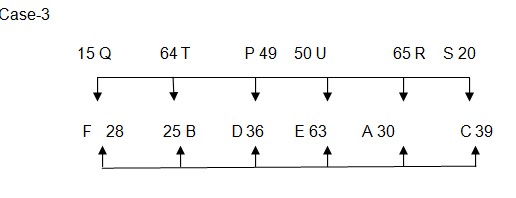
More Cause and effect Questions
- Statement : "The government has decided to provide free healthcare facilities to all senior citizens above the age of 60." Assumptions : I. Senior citize...
- independent causes or may be effects of independent causes or a common cause. One of these statements may be the effect of the other statement. Read both t...
- Statements: 1.The government reduced the interest rates on home loans. 2. There has been a significant rise in the purchase of new houses.
- Four of the five among the following are similar in such a way to form a group, which one of the following doesn’t belong to the group?
- Event (A): The announcements filed by listed companies will be disseminated directly on the NSE website without the exchange's intervention. Event (B): NSE...
- Statements: I. The top earning Mumbai area is Santa Cruz, where the richest folks in Mumbai's business community live. II. Many average to poor households...
- Statements: 1. Many schools in the city remained closed for a week. 2. The city witnessed heavy flooding due to incessant rains.
- In the question below, two statements (I) and (II) are given. These statements may be either independent causes or may be effects of independent causes or ...
- Event (A): A major reason for diseases like Parkinson’s, which don’t have a cure yet-is aggregation of toxic proteins and inefficient autophagy or the com...
- In each of the following questions, two statements numbered I and II are given. There may be cause and effect relationship between the two statements. Thes...
Relevant for Exams:
Hey! Ask a query
Please enter email id
The email must be a valid email address.
Please enter Mobile Number
Please enter valid Mobile Number
Please enter your Doubt

Think You're Ready for RBI Grade B?
RBI Grade B 2026 Phase 1 Memory Based Paper
- 200 Questions with Detailed Solutions
- Section-wise Coverage (GA, English, Quant & Reasoning)