


Question
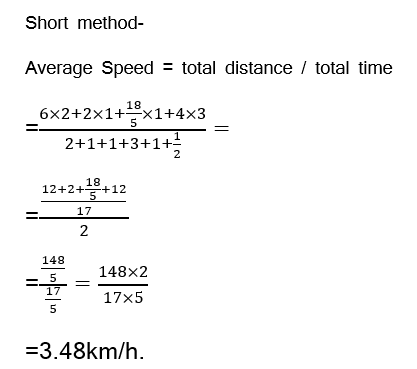
Some students went on a field trip. At a speed of 6 km/h, they traveled by bike for 2 hours then at a speed of 2 km/h, they walked for another hour; then they rested for an hour and had lunch for half an hour; then at a speed of 1 m/s, they walked for an hour to visit a garden; and finally at a speed 4 km/h, they returned home in 3 hours. Their average speed, in km/h,(rounded off to two places of the decimal) is:
More Time and distance Questions
- On travelling with 30% less speed than his actual speed, Arjun reached the destination 2 hours late. Find the approximate time taken by him to reach his de...
- While going to a destination after travelling 75km, the driver noticed some problem in the clutch of the train due to which he had to proceed at 2/5 of its...
- A car travels the distance AB at x km/hr and then travels BC at 3x/4 km/hr . If its average speed for the entire journey is 35 km/hr , and AB = 36...
- A cyclist goes 30 km at speed x km/h and returns 30 km at speed (x - 5) km/h. Total time taken is 5 hours. Find x.
- Amit takes 3 hours more than Rohit to cover a distance of 120 km. If Amit doubles his speed, he takes 1 hour less than Rohit to cover the same distance. Fi...
- A car running with a speed of ‘x’ m/sec makes 9 rounds of a circular field having radius 49 metres, in 12 seconds. Find the time taken by car to cover 600 ...
- A car running with a speed of ‘x’ m/sec makes 5 rounds of a circular field having radius 42 metres, in 10 seconds. Find the time taken by car to cover 300 ...
- Speed of three friends P, Q and R are in the ratio of 7:6:5. If R covers a fixed distance in 40 minutes, how many minutes will P take to cover that same di...
- Two individuals, A and B, travel from point M to point N at different speeds. A takes 6 hours to complete the journey, while B takes 8 hours. The differenc...
- A biker travels first half of his journey with a speed of 18 km/h and the other half with a speed of 'x' km/h. If the total distance traveled by him is 180...
Hey! Ask a query
Please enter email id
The email must be a valid email address.
Please enter Mobile Number
Please enter valid Mobile Number
Please enter your Doubt

Think You're Ready for RBI Grade B?
RBI Grade B 2026 Phase 1 Memory Based Paper
- 200 Questions with Detailed Solutions
- Section-wise Coverage (GA, English, Quant & Reasoning)