


Question
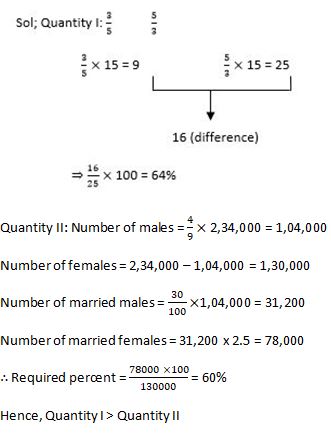
Quantity I: A student multiplied a number by 3/5 instead of 5/3. What is the % error in the calculation? Quantity II: The population of a town is 2,34,000. 4/9 of them are males. If 30% of males are married and number of married females is 2.5 times of married males. Find the percent of married females out of total females in the town?
More Quantity Inequality Questions
- Quantity-I: The area of a triangle is 72 cm². The base of the triangle is 12 cm. Find the height of the triangle. Quantity-II: The area of a rectangle is ...
- The following questions each present two quantities, Quantity I and Quantity II. Compare the values of the two quantities and determine their relationship....
- Quantity I: A and B can complete a work together in 12 days. After working together for 6 days, A leaves, and B finishes the remaining work in 10 more days...
- Quantity I: Akash is 50% more efficient than Ramesh and three times as efficient as Suresh. Suppose Ramesh and Suresh work together, they can complete the ...
- The sum of the cost price of articles A and B is Rs.500 while the ratio of their cost prices is 2:3 respectively. Quantity I: If article A is marked 52% ab...
- Quantity I: A bag contains 5 red, 7 blue, and 8 green balls. Two balls are drawn randomly. What is the probability that both balls drawn are green? Quantit...
- Quantity I: There are two types of animals in a pet shop. Some are puppies and some are kittens. Each kitten takes 8 biscuits and each puppy takes 11 biscu...
- In the question, two quantities I and II are given. You have to solve both the quantities to establish the correct relation between Quantity-I and Quantity...
- In the question, two Quantities I and II are given. You have to solve both the Quantities to establish the correct relation between Quantity-I and Quantity...
- Quantity-I: Average number of tablets sold by a company from January to May is 480, while average number of tablets sold by the same company from May to De...
Hey! Ask a query
Please enter email id
The email must be a valid email address.
Please enter Mobile Number
Please enter valid Mobile Number
Please enter your Doubt

Think You're Ready for RBI Grade B?
RBI Grade B 2026 Phase 1 Memory Based Paper
- 200 Questions with Detailed Solutions
- Section-wise Coverage (GA, English, Quant & Reasoning)