


Question
P and Q start from point A to point B, at the same time at speeds of 32 km/h and 40 km/h, respectively. If in covering the journey P takes 15 minutes longer than Q, the total distance AB of the journey is:
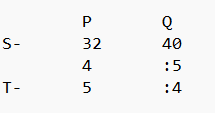 ATQ- 1=15min =1/4 hours Covering distance by Q =40t And Covering distance by P=32(t+1/4) Since both expressions represent the same distance d, we can set them equal to each other. 40t=32(t+1/4) 40t=32t+8 t=1hours. Then distance =40×1=40km.
More Previous year papers Questions
- Question 1
- At the rate of any compound interest rate, it gets tripled in 4 years, in how many years it will become 2187 times its own?
- Replace the question mark with an option that follows the same logic applied in the first pair. S : 40 :: W : ??
- Length of a rectangle is 7 cm more than its breadth and length of diagonal of the rectangle is 13 cm. What is the area of a square having perimeter same as...
- If cos A + cos² A = 1, then the value of sin⁴ A + sin⁶ A is:
- If (a - b) is 4 more than (c + d) and (a + b) is 2 more than (c - d), then the value of (a - c), is:
- In what ratio should Darjeeling Tea costing Rs. 400 per kg be mixed with Assam Tea costing Rs. 300 per kg, so that by selling the mixture at Ra. 408 per kg...
- The profit obtained by a vendor on selling goods at ₹3,200 is equal to 7/5th of the profit obtained by selling the same goods at ₹3,000. What is the cost p...
- A person crosses a 900-metre long street in 6 minutes. The speed of the person, in km/h, is:
- If Marked price of an article is Rs. 4500 and selling price is Rs. 3900. What is the discount?
Relevant for Exams:
Hey! Ask a query
Please enter email id
The email must be a valid email address.
Please enter Mobile Number
Please enter valid Mobile Number
Please enter your Doubt

Think You're Ready for RBI Grade B?
RBI Grade B 2026 Phase 1 Memory Based Paper
- 200 Questions with Detailed Solutions
- Section-wise Coverage (GA, English, Quant & Reasoning)