


Question
A and B can complete a job together in 12.5 days; B and C can complete the same job together in 18.75 days, while C and A can complete the same job together in 15 days. In how many days will A, B and C together be able to complete the same job alongside D, who is only 40% as efficient as C?
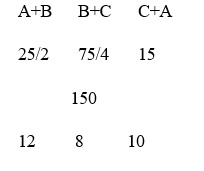 Total 2(A+B+C)= 12+8+10=30 A+B+C =15 C = 15-12=3 D= 3×40/100=1.2 NOW A+B+C+D = 15+1.2=16.2 SO total days = 150/16.2 =1500/162=250/27
More Previous year papers Questions
- What is the average of all integers between 150 and 300 that are exactly divisible by 13?
- The clock is divided into ............. equal minute divisions?
- A boat goes 434 km upstream in 62 hours and a distance of 648 km downstream in 72 hours. Find the speed of the boat in still water. (In kmph)
- If the value of x satisfies the equation (125 × 4 – x × 2)/x + 50 = 200/x, then the sum of all the possible values of x is?
- The average of the first 10 prime number is:
- Find the value of the expression:
- The classification of 100 students based on the marks obtained by them in English and Mathematics in an examination is given in the table below. Study the ...
- When a number is first increased by 18% and then decreased by 18%, the change in the number is ____________.
- What is the LCM of 6,7,8 and 9?
- The present ages of A and B are in the ratio 3:5. After 8 years, the ratio will become 2:3. What is the present age of A?
Hey! Ask a query
Please enter email id
The email must be a valid email address.
Please enter Mobile Number
Please enter valid Mobile Number
Please enter your Doubt

Think You're Ready for RBI Grade B?
RBI Grade B 2026 Phase 1 Memory Based Paper
- 200 Questions with Detailed Solutions
- Section-wise Coverage (GA, English, Quant & Reasoning)