


Question
In an election there are a total of 4,000 registered voters out of which x% of voters did not cast their votes and 180 votes are declared invalid. The winner got 740 votes more than the losing candidate. The number of valid votes received by the winner are 42% of the total registered voters. How many registered voters did not cast their vote?
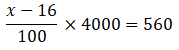 x – 16 = 14 x = 30 Registered voters who did not casted their votes = x% of 4000 = 30% of 4000 = 1200 Hence, option a) is the correct answer.
More Percentage Questions
- When A's income is doubled and his expenditure remains unchanged, his savings increase by Rs. 40,000. If B's income is 15% higher than A's initial income a...
- A bag contains 650 coins of 25p denomination and 1300 coins of 50p denominations. If 19% of 25p coins and 38% of 50p coins are removed, the percentage of m...
- If the length of a rectangle is increased by 60%, what would be the percentage decrease (correct to the nearest integer) in the width to maintain the same ...
- 20% of ‘x’ and 40% of ‘y’ together make 138. If ‘y’ is 36 more than ‘x’, then find the value of (2x – y).
- A man invests 'x'% of his monthly salary of Rs. 48,000 at an interest rate of 12.5% simple interest. After 4 years, the interest earned amounts to Rs. 10,8...
- If a number is added to 52 instead of being added to 25. Approximately what percent of the correct value of the result?
- Income of 'M' is 30% more than that of 'N'. 'M' and 'N' save 50% and 40% of their respective incomes. If their expenditure difference is Rs. 600, what is t...
- A person saves 20% of his monthly earnings. If his monthly earnings increase by 70%, then by how much percent should he increase his monthly expenditure so...
- Income of Meera is 12.5% more than the expenditure of Riya. Income of Riya is 40% more than the expenditure of Meera. If savings of Riya is Rs. 2,000 more ...
- A man spends 30% and 18% of his monthly salary on rent and transportation, respectively. Out of the remaining money, he spends 29% on food and 44% on enter...
Relevant for Exams:
Hey! Ask a query
Please enter email id
The email must be a valid email address.
Please enter Mobile Number
Please enter valid Mobile Number
Please enter your Doubt

Think You're Ready for RBI Grade B?
RBI Grade B 2026 Phase 1 Memory Based Paper
- 200 Questions with Detailed Solutions
- Section-wise Coverage (GA, English, Quant & Reasoning)