


Question
B1 is a point on the side AC of ∆ ABC and B1B is joined. line is drawn through A parallel to B1B meeting BC at A1 and another line is drawn through C parallel to B1B meeting AB produced at C1. Then
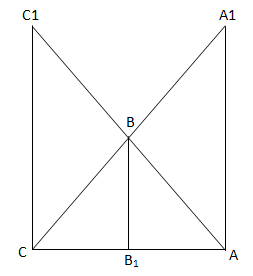 ∆AA1C & ∆BB1C AA1 ‖ BB1 (BB1) / (AA1) = (B1C) / (AC) By ratio of Similarity in ∆ACC1 ~ ∆ABB1 = BB1 ‖ CC1 = (BB1) / (CC1) = (AB1) / (AC) = (BB1) / (CC1) = (AC – B1C) / (AC) = (BB1) / (CC1) = 1 – ((B1C) / (AC) from (1) (BB1) / (CC1) = 1 – (BB1) / (AA1) BB1[1/CC1 + 1 / AA1] = 1 = (1 / CC1) + (1 / AA1) = (1 / BB1)
More Geometry Questions
- What is the sum of the supplementary and complementary angles of 60 ° ?
- O and C are the respectively orthocentre and circumcentre of ∆PQR. The line PO is extended which intersect line QR at S. such that, ∠QCR = 140°, ∠PQS = 58°...
- In a rectangle PQRS, there is a point A located within the interior of the rectangle. The distances from point A to three vertices of the rectangle are as ...
- If G is the centroid and AD, BE, CF are three medians of ∆BDG with area 6cm 2 , then the area of ∆ABC is?
- Question 5
- The length of the each side of an equilateral triangle is 42√3. The area of incircle, (cm 2 ) is
- If in a ΔABC, D is a point on BC such that BD = 5cm , BC = 9 cm then what is ratio of area of ΔABD to area of ΔADC ?
- If I is the incentre of ΔABC , if ∠ BAC = 700 , then what is the measure of ∠ BIC?
- AC and CE are the medians of triangle ABD and ACD respectively. If area of triangle ACE is 15 cm 2 , then find the area of triangle ABD.
- The area of a field in the shape of a hexagon is 2400 √ 3 m2 ? What will be the cost of fencing it at ₹18.50 per metre?
Relevant for Exams:
Hey! Ask a query
Please enter email id
The email must be a valid email address.
Please enter Mobile Number
Please enter valid Mobile Number
Please enter your Doubt

Think You're Ready for RBI Grade B?
RBI Grade B 2026 Phase 1 Memory Based Paper
- 200 Questions with Detailed Solutions
- Section-wise Coverage (GA, English, Quant & Reasoning)