


Question
What is the ratio between the sum of the number of girls and boys in school A and the number of teachers in school C?
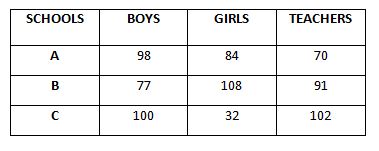 Required ratio = (98 + 84) : 102 = 91:51
More Caselet DI Questions
- How many males work in the Accounts department?
- Difference between discount offered by Company B and cost of Company A.
- If ratio of male to female in Operation is 5:3, then total male employees in Operation are what percent of total employees in HR?
- Find the ratio of number of Green apples sold by ‘P’ and ‘S’ respectively.
- Study the given graph and answer the question that follows.
- Find the ratio of the number of female of tribe Raba and Dimasa.
- Find the total number of students who play Football.
- If 25% of the female employees leave the job from company C and 15% of the male employees joins company A, then find the difference between the number of f...
- Find the number of female employees working in company C.
- What is the difference between the number of teachers from school B and the average number of girls from school A and B?
Hey! Ask a query
Please enter email id
The email must be a valid email address.
Please enter Mobile Number
Please enter valid Mobile Number
Please enter your Doubt

Think You're Ready for RBI Grade B?
RBI Grade B 2026 Phase 1 Memory Based Paper
- 200 Questions with Detailed Solutions
- Section-wise Coverage (GA, English, Quant & Reasoning)