


Question
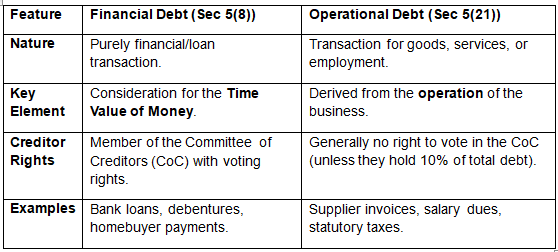
In light of the Supreme Court's jurisprudence on the Insolvency and Bankruptcy Code, 2016, and the statutory definitions under Section 3, which of the following scenarios would NOT qualify as a 'Financial Debt' despite fitting the general definition of 'Debt' under Section 3(11)?"
More Administrative Interpretation and Maxims Questions
- As per the Bharatiya Nyaya Sanhita, 2023 ____________ means a group of two or more persons who, acting either singly or jointly, as a syndicate or gang ind...
- According to Motor Vehicles Act an offer of settlement is accepted by the Claimant then the Insurance company shall pay the amount of compensation in:
- Where there is an unconditional contract for the sale of specific goods in a deliverable state, the property in the goods passes to the buyer
- Who is entitled to appoint another person as a proxy as per the Companies Act?
- Which section of the Companies Act lays down provisions relating to document containing offer of securities for sale to be deemed prospectus?
- Ankit, a tradesman, leaves goods at Sushil’s house by mistake. Sushil treats the goods as his own. Sushil _______________
- When one person signifies to another his willingness to do or to abstain from doing anything, with a view to obtaining the assent of that other to such act...
- According to the Occupational Safety, Health, and Working Conditions Code, 2020, what can an Inspector-cum-Facilitator do if they find an article or substa...
- According to Code 42 of the Occupational Safety, Health and Working Conditions Code, 2020, when can an industrial dispute be referred to arbitration?
- A Special Court may, if it thinks fit, try in a summary way any offence under the Companies Act which is punishable with _______________
Relevant for Exams:
Hey! Ask a query
Please enter email id
The email must be a valid email address.
Please enter Mobile Number
Please enter valid Mobile Number
Please enter your Doubt

Think You're Ready for RBI Grade B?
RBI Grade B 2026 Phase 1 Memory Based Paper
- 200 Questions with Detailed Solutions
- Section-wise Coverage (GA, English, Quant & Reasoning)