


Question
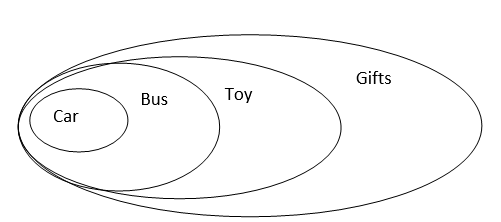
In this question, three statements are given, followed by two conclusions numbered I and II Assuming the statements to be true, even if they seem to be at variance with commonly known facts, decide which of the conclusions logically follow(s) from the statements. Statements: • All cars are buses. • All buses are toys. • All toys are gifts. Conclusions:
In this question, three statements are given, followed by two conclusions numbered I and II Assuming the statements to be true, even if they seem to be at variance with commonly known facts, decide which of the conclusions logically follow(s) from the statements. Statements: • All cars are buses. • All buses are toys. • All toys are gifts. Conclusions:
I. All cars are gifts.
II. Some toys are cars.
More Syllogism Questions
- In the given question, two conclusions are given and five statements as 1), 2), 3), 4) and 5). You need to choose the option that contains the set of state...
- In the question below there are four statements followed by four conclusions I, II, III and IV. You have to take the four given statements to be true even ...
- Statements- Some pens are sharpeners All sharpeners are erasers No eraser is ink Some inks are pencil Conclusions. I. Some pencil are not erasers. ...
- Statements: Some pastries are toffees. All toffees are chocolates. All chocolates are sandwich. Conclusions: I. All toffees are sandwich. II. Some pa...
- Statement : No ocean is a land. Some lands are boundaries. All boundaries are banks. Conclusion : I. No ocean is a boundaries. II. All banks are la...
- In the question below some statements are given followed by two conclusions I and II. You have to take the given statements to be true even if they seem to...
- Statements:Some pastries are cakes. No cake is a pudding. All puddings are sweets. Conclusions:I. Some sweets are not cakes. II. Some pastries are not pudd...
- Conclusions: No Maruti is Toyota. Some Honda are Kia. Statements:
- Two statements are given followed by two conclusions numbered I & II. Assuming the statements to be true, even if they seem to be at variance with commonly...
- Statements: Only a few constellation is movement All springs is constellation Only constellation is screw Conclusions: I. All screw can be spring II....
Relevant for Exams:
Hey! Ask a query
Please enter email id
The email must be a valid email address.
Please enter Mobile Number
Please enter valid Mobile Number
Please enter your Doubt

Think You're Ready for RBI Grade B?
RBI Grade B 2026 Phase 1 Memory Based Paper
- 200 Questions with Detailed Solutions
- Section-wise Coverage (GA, English, Quant & Reasoning)