


Question
Statement :No cup is a medal. All medals are trophies. No trophy is a shield. Some shield are prizes. Conclusion:
Statement :No cup is a medal. All medals are trophies. No trophy is a shield. Some shield are prizes. Conclusion:
I. Some medals are shields.
II. Some medals are not shields.
III. Some trophies being cups is a possibility.
IV. All trophies may be prizes.
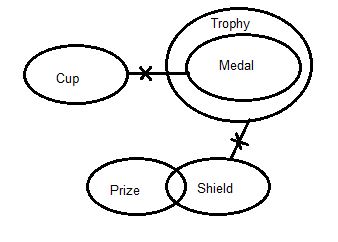
More Syllogism Questions
- Statements: Each bachelor is spinster. Some spinsters are married. No spinster is unmarried. Conclusions: I: No bachelor is unmarried. II: Some married are...
- Statement: At-least some chairs are tables. A few tables are fans. Only a few windows are tables. All tables are doors. Conclusion: 1. All fans being chai...
- In the questions given below, there are three statements followed by three conclusions I, II and III. You have to take the three given statements to be tru...
- How many children does Mr. Raman has? I. Mr. Raman has eight sons and each has one sister. II. Number of sons of Mr. Raman is eight times the number of h...
- Statement: Each A is Z. Only a few Z are B. Some B are Y. Conclusion: I. All Z are A. II. All A are not B. III. Some Z being Y is a possibility. IV. All A...
- Statements: Some guests are hosts All hosts are invitations No invitation is a decoration Conclusion: I. Some guests are not decoration II. No host is a de...
- In the questions given below, there are three statements followed by three conclusions I, II and III. You have to take the three given statements to be tru...
- Statement: A few Creams are green. Only green are Pink. Only a few Pink are brown. No brown are red. Conclusion: I. No cream is red. II. Some gre...
- Statement: Some Sundays are Monday. Only a few Monday are Tuesday. All Wednesday are Tuesday. None of the Mondays are Thursday. Conclusion: I. Some T...
- Statements: All bags are polythenes. Some polythenes are points. Only a few points are jutes. No jute is plastic. Conclusions: I. All bags are...
Relevant for Exams:
Hey! Ask a query
Please enter email id
The email must be a valid email address.
Please enter Mobile Number
Please enter valid Mobile Number
Please enter your Doubt

Think You're Ready for RBI Grade B?
RBI Grade B 2026 Phase 1 Memory Based Paper
- 200 Questions with Detailed Solutions
- Section-wise Coverage (GA, English, Quant & Reasoning)