


Question
Statements : All glasses are cups No cups are spoons. Some spoons are forks. Conclusions :
Statements : All glasses are cups No cups are spoons. Some spoons are forks. Conclusions :
I. Some forks are cups.
II. Some spoons are not glasses.
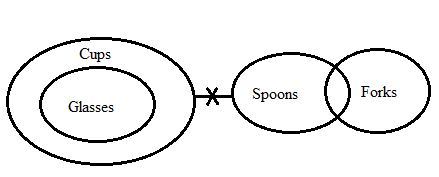 No cups are spoons(E) + Some spoons are forks(I) ⇒ Some forks are cups(O*). Hence, conclusion I does not follow. All glasses are cups(A) + No cups are spoons(E) ⇒ No glass is a spoon(E) ⇒ Conversion ⇒ Some spoons are not glasses(O). Hence, conclusion II follows.
More Syllogism Questions
- In the question below there are three statements followed by two conclusions I and II. You have to take the three given statements to be true even if they ...
- Statements: Only a few Ear are Eye. No Eye is a Hand. Only a few Hand is Leg. Conclusions: I. All Legs can never be Eyes. II. All Ears can never be Hands. ...
- Read the given statements and conclusion carefully. Assuming the information given in the statement is true, even if it appears to be at variance with comm...
- Statements: Some monitors are keyboard. All keyboard are laptop. Some laptop are computer ...
- Statements: No watches are mobile. Some mobile is earphone. Only a few earphones is bike. Only a few bike is car. Conclusions: I). Some Earphone is not ...
- Statements: Only a few passage is comprehension A few comprehension is language All language is story Conclusions: I. Some passage is not comprehensio...
- Statements: Only a few Elements is Compounds. Only a few Acids is Elements. No Acid is Neutral. Conclusions: I. Every Elements can be Acids. II. No Neutral...
- Statement: Some A are B Only a few B are C No A is D Conclusion: I.At least some A are C II. All B are C is a possibility III. No D is C
- Statements: Only a few machine is tool All tools are menus Only a few menu is script Conclusions: I. Mostly tool can be script II. All machines can n...
- Statements:Some Pulsar are not bajaj. All bajajs are Hero. Conclusions:I. Some bajaj are not Pulsar. II. Some Heros are not bajaj. III. All b...
Relevant for Exams:
Hey! Ask a query
Please enter email id
The email must be a valid email address.
Please enter Mobile Number
Please enter valid Mobile Number
Please enter your Doubt

Think You're Ready for RBI Grade B?
RBI Grade B 2026 Phase 1 Memory Based Paper
- 200 Questions with Detailed Solutions
- Section-wise Coverage (GA, English, Quant & Reasoning)