


Question
Four of the following were in a certain group, which of the following that does not belong to that group?
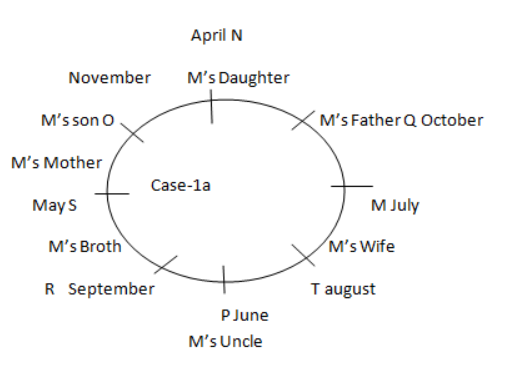
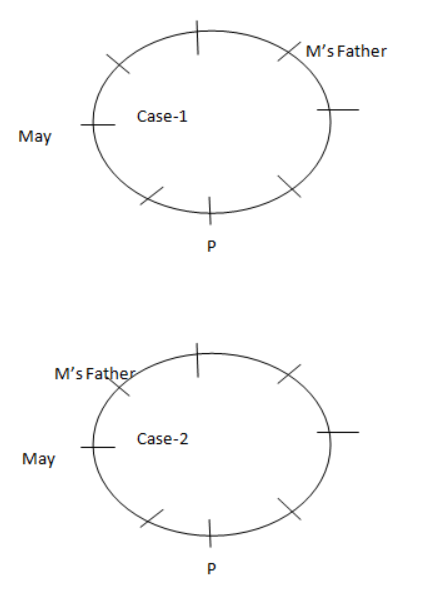 M and his father were immediate neighbours. Two persons were seated between M and the one who attend the seminar in September. The one who attends the seminar in September is nephew to P and both were seated adjacent to each other.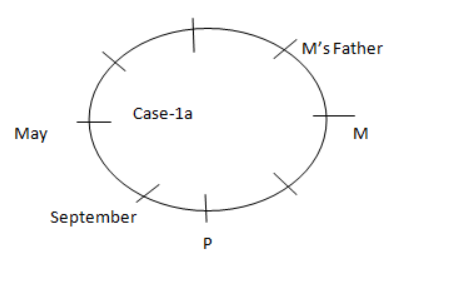
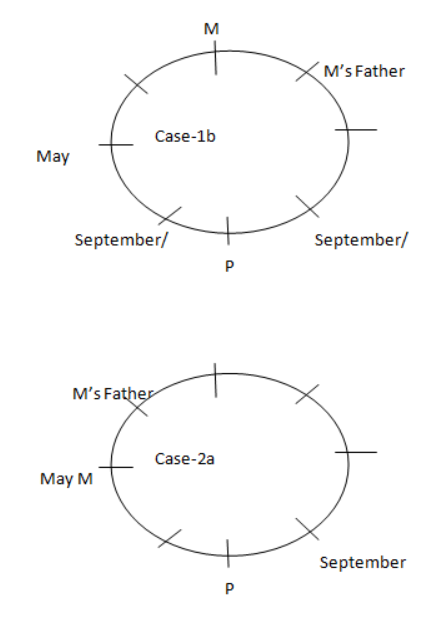
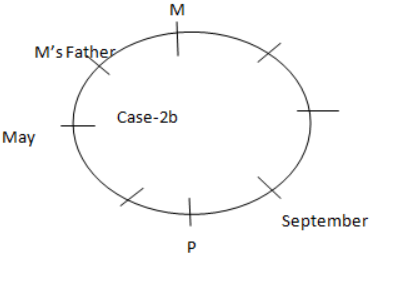 O, who is the son of M was seated to the immediate right of his sister and attend the seminar after M but not immediately. Q is married to the only sister of the one who attends the seminar in June and was seated to the immediate left of M’s daughter. Two persons were seated between N and M’s wife. Q is from 1st generation. P is not the brother of M’s wife. Two persons were seated between Q and the one, who attended the seminar June. The one, who attended the seminar in May doesn’t face the one, who attended the seminar June. O and P are not neighbours. Two possibilities in blood relation.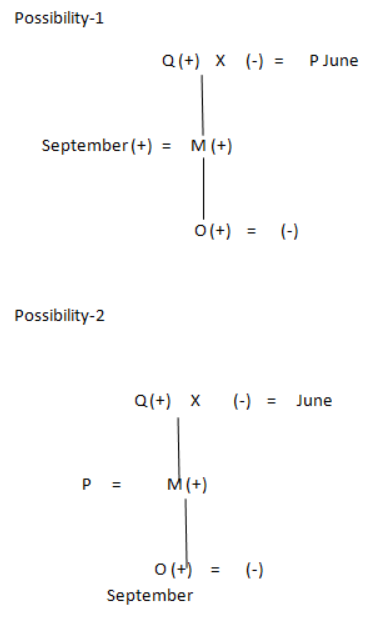
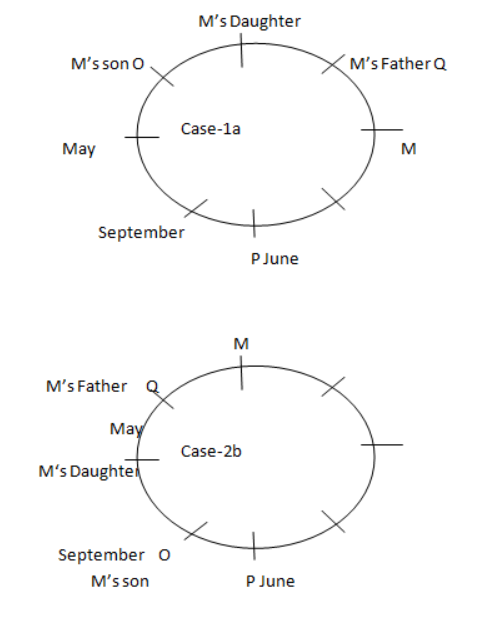 Hence, case 1b and case 2a are invalid because O was seated to the immediate right of M’s daughter and Q was seated to the immediate left of M’s daughter. Case 2b is invalid because P cannot attend the seminar in June (possibility 2 of blood relation diagram) So, possibility 2 of blood relation diagram is invalid.
 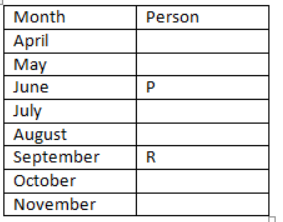 Only one female attend the seminar after June. S and her brother attend the seminar on consecutive months. Two persons attend the seminar between P and R. T attend the seminar in August.
 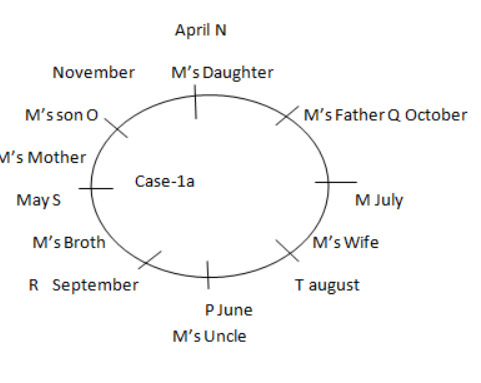 So, the final solution is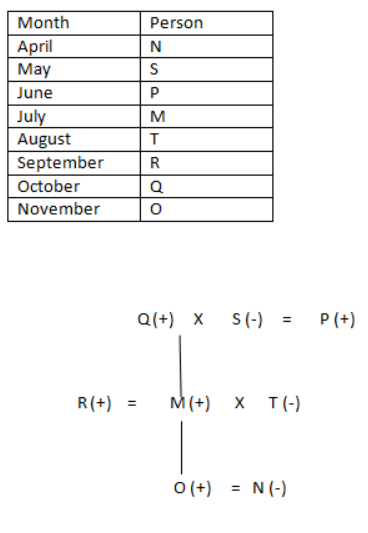
More Seating Arrangement Questions
- Which of the following statement(s) is/are true? I. F and A are immediate neighbors II. Only one person sits between K and T when counted from the left of ...
- How is O related to T’s brother?
- How many coins does W have?
- Who among the following person sits seventeenth from the right end?
- Six persons D, E, F, G, H and I sit in a straight row facing north. I sits third to the right of H. D sits immediate left of G. G sits third to the left of...
- Find the total distance travelled by him before reaching railway station ?
- What is the position of A with respect to F?
- Study the following information to answer the given questions F, G, H, I, J, K, L and M are sitting around a circle facing the center. G is third to the r...
- In which of the following statement the third person faces the one who sits exactly between the first and the second person in the following arrangement? I...
- If all the persons are made to sit in alphabetical order in a clockwise direction with respect to G, then how many persons remain unchanged in their positi...
Relevant for Exams:
Hey! Ask a query
Please enter email id
The email must be a valid email address.
Please enter Mobile Number
Please enter valid Mobile Number
Please enter your Doubt

Think You're Ready for RBI Grade B?
RBI Grade B 2026 Phase 1 Memory Based Paper
- 200 Questions with Detailed Solutions
- Section-wise Coverage (GA, English, Quant & Reasoning)