


Question
Who is sitting second to the right of G?
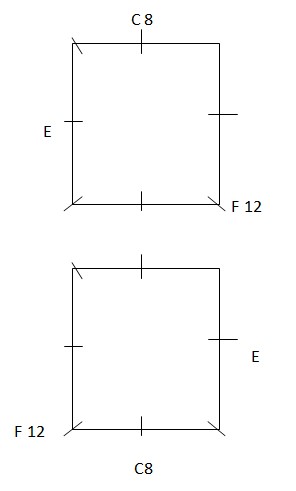
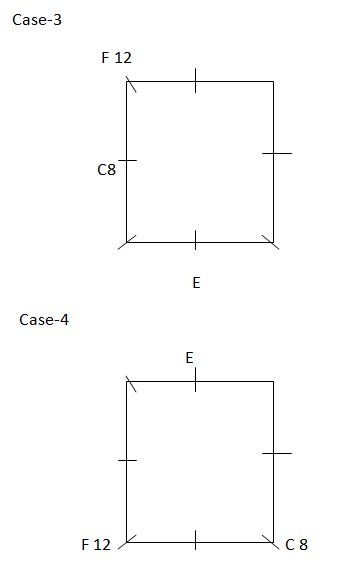 G, who is 1 year elder than D, is sitting opposite to D. A is 2 years elder than B, and both of them are either sitting at the corner or at the edge. A and G are not immediate neighbors. Now, G is sitting opposite to D which is not possible in case I and III so, these cases are rejected. Also, in case IV, if we place G and D opposite then we can’t place A and B on the same side of the table so, case IV is also rejected. A must be 5 years old and B must be 3 years old also, D must be 9 years old which means G is 10 years old. Then final arrangement is shown below: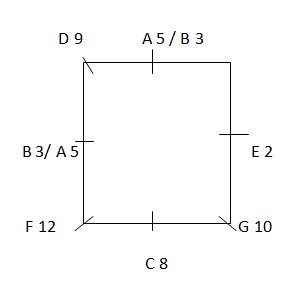
More Seating Arrangement Questions
- Which of the following is true for F?
- Who of the following group is facing south direction?
- If Q interchange its position with the person who paid Rs. 250, then what is the new position of Q from the right end?
- What is the position of Z with respect to father of Y?
- Who site second to the right of E.
- Who is the husband of V?
- Eight persons J, K, L, M, N, O, P and Q are sitting around a circular table and faces towards the centre. J is sitting third to the right of P and second t...
- Who sits second to the right of Z?
- How many known persons are seated in row 3?
- How many persons sit between G and the one who likes Bhopal?
Relevant for Exams:
Hey! Ask a query
Please enter email id
The email must be a valid email address.
Please enter Mobile Number
Please enter valid Mobile Number
Please enter your Doubt

Think You're Ready for RBI Grade B?
RBI Grade B 2026 Phase 1 Memory Based Paper
- 200 Questions with Detailed Solutions
- Section-wise Coverage (GA, English, Quant & Reasoning)