


Question
In which of the following pair 2nd person doesn’t sit second to right of 1st person?
 Again, we have: D sits third to left of B. Since, C is unmarried member of the family, thus C can’s be (1) & (2) at any possible condition. Only two married couples are there in the family. E is the daughter of H, since B is only daughter of F, thus F and H can’s be married. Either both or none of the parent is alive, that means H must be father of E and is married to D. C is an immediate neighbor of C’s father and C’s mother. C and E doesn’t sit together, that means C is not the child of E. If C is the son of F then A should be Mother of C but, Two person sits between C’s father and A from this statement C is also not a son of F, thus only possible condition is C is son of H. Since, gender of C and B are different, thus C must be brother of E. That means we have two possible position of C, in case (1) C sits immediate left of D, in case (2) C sits immediate right of D. Based on above given information we have: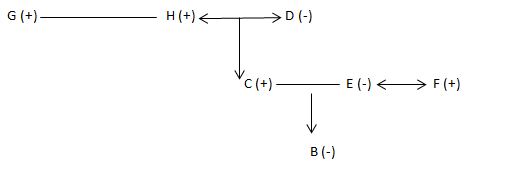
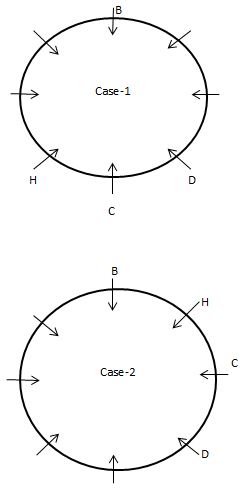 Again, we have: Only three person sits between E’s brother and F, that means in case (2) F sits facing C and case (1) is not valid. Two person sits between C’s father and A. E’s son and E doesn’t sit together, since only two remaining person are E and G, thus E must be mother of A. Based on above given information we have:
 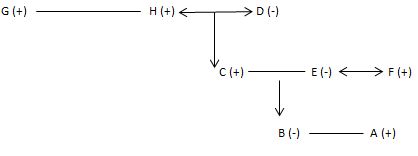 Case (1) is not valid as only three person sits between E’s brother and F.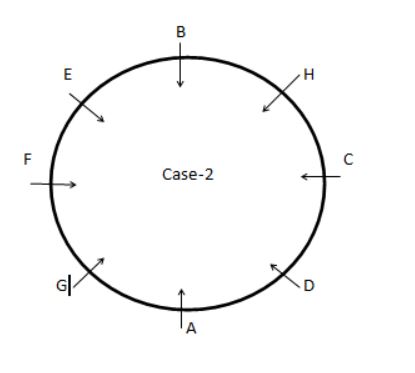
More Seating Arrangement Questions
- Who among the following person sit immediate right of T?
- If positions of A and D are interchanged, what will be the position of A with respect to the person who speaks English?
- Eight friends, R, S, T, U, V, W, X and Y are sitting in a line facing north. V is sitting at one of the corners. S is sitting between Y and T. X is sitting...
- Four of the five are alike in a certain way and hence forms a group. Who among the following does not belong to that group?
- Who sits immediate left of Q?
- Who among the following attends the seminar immediately after M’s brother?
- Who likes Orange?
- Four of the following five are alike in a certain way and hence form a group. Who among the following person does not belong to that group?
- Six girls J, K, L, M, N and O are sitting around a circular table, facing the centre. O is sitting third to the left of N. M is sitting to the immediate ri...
- How many of them earn more than Lalit?
Relevant for Exams:
Hey! Ask a query
Please enter email id
The email must be a valid email address.
Please enter Mobile Number
Please enter valid Mobile Number
Please enter your Doubt

Think You're Ready for RBI Grade B?
RBI Grade B 2026 Phase 1 Memory Based Paper
- 200 Questions with Detailed Solutions
- Section-wise Coverage (GA, English, Quant & Reasoning)