


Question
How many people are standing between G and D in a straight line of 15 people (Note: All are standing in a straight line facing north.)?
How many people are standing between G and D in a straight line of 15 people (Note: All are standing in a straight line facing north.)?
I. F stands fifth from the left end of the line. G and E are immediate neighbours of F. Only two people stand between F and
D.
II. H stands third from the right end of the line. Only six people stand between E and H. Only one person stands between G and E. E stands exactly between G and
D.
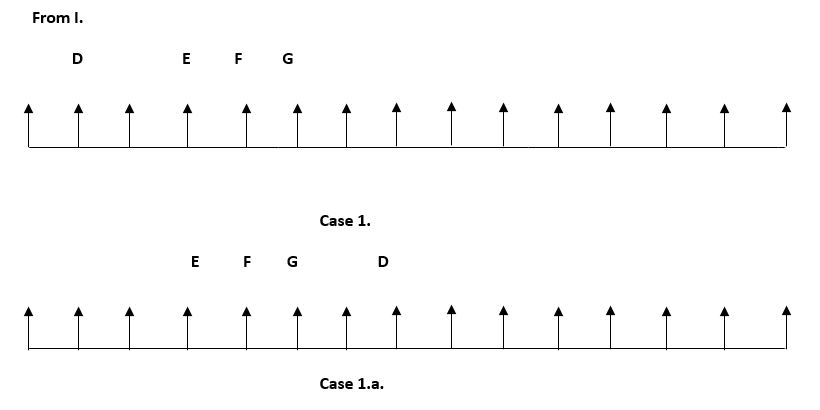 Hence statement I alone is not sufficient to answer the question.
 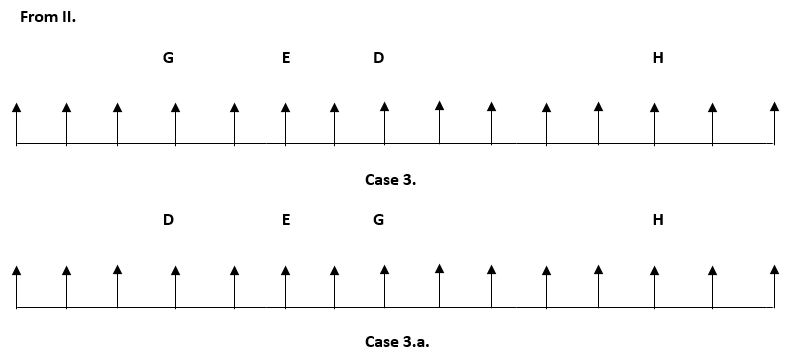 Three people are standing between G and D. Hence Hence statement II alone is sufficient to answer the question.
More Reasoning Miscellaneous Questions
- An email account that is accessed through a Web browser& emails are typically not downloaded to the user's computer but stored on the Web-based email servi...
- In a coding language, the code for ‘DUST’ is ‘@ % A $’, the code for ‘TOLD’ is ‘# @ $ B’ andthe code for ‘SAR’ is ‘% * F’. What will be the code for ‘DART’...
- Statements: Only Apple are Banana. Some Apples are Pears. Only a few Papaya is Pear. Conclusions: I. At least Some Papayas are Bananas. II. At least Some P...
- Anita spends 18% of her monthly income on rent and 70% of the rest on household expenditure. If she saves Rs. 1,890, then find her monthly income.
- What is the position of C with respect to the one who sits to the immediate right of Z?
- What is the shortcut key for 'Copy' in Windows?
- How far is Atul from Nisha?
- A trader sold two gadgets for Rs. 120 each. One was sold at a profit of 20%, and the other at a loss of 25%. Find the difference in their cost prices.
- The position of how many alphabets will remain unchanged if each of the alphabets in the word ‘BLOCKBUSTER’ is arranged in alphabetical order from left to ...
- 1. Walls 2. Floor 3. Roof 4. Room 5. Foundation 6. Window
Hey! Ask a query
Please enter email id
The email must be a valid email address.
Please enter Mobile Number
Please enter valid Mobile Number
Please enter your Doubt

Think You're Ready for RBI Grade B?
RBI Grade B 2026 Phase 1 Memory Based Paper
- 200 Questions with Detailed Solutions
- Section-wise Coverage (GA, English, Quant & Reasoning)