


Question
Four of the following five are alike in a certain way based on the given arrangement and so form a group. Which is the one that does not belong to that group?
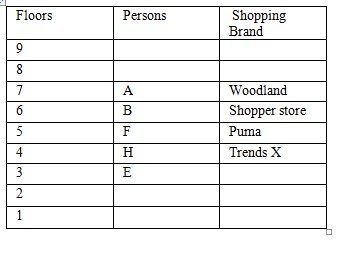 Case-2
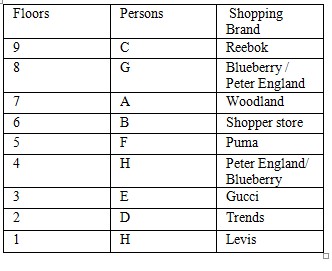
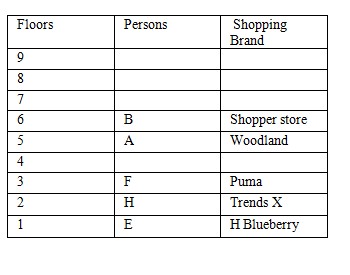 From the given statements, two persons live between G and the one who shops in Puma which is not possible in this case and case 2 is eliminated. On behalf of the remaining data I shops in Levis. The number of persons above G is same as below of the one who shops in Trends. More than four persons live between C, who shops in Reebok and E, who does not shop in Blueberry. Three persons live between the one who shops in Peter England and Blueberry and both of them live on even floors. We get our final arrangement from Case1. The final arrangement is following:
More Puzzles Questions
- Four of the following five are alike in a certain way and hence form a group. Which of the following one that does not belong to the group?
- Statements: E > G > J ≥ K = L; H > M < L > F > T Conclusions: I). G > K II). E > T
- P, Q, R, S, T, U, and V live on seven different floors of the same building. The lowermost floor in the building is numbered 1, the floor above it is numbe...
- What will be the sum of ages of Second youngest and Third eldest person in the group?
- How many boxes are kept above the box with White?
- Three of the following four options are alike in a certain way based on the Alphabetical series. Which one among the following doesn’t belong to the group?
- Which of the following boxes is numbered 331?
- How many persons participate before D?
- How many persons opted both Mathematics and Biology?
- Six persons (P, Q, R, S, T, and U) live in a building of six-floors. The bottommost floor is numbered as 1 and the topmost floor is numbered as 6. T lives ...
Relevant for Exams:
Hey! Ask a query
Please enter email id
The email must be a valid email address.
Please enter Mobile Number
Please enter valid Mobile Number
Please enter your Doubt

Think You're Ready for RBI Grade B?
RBI Grade B 2026 Phase 1 Memory Based Paper
- 200 Questions with Detailed Solutions
- Section-wise Coverage (GA, English, Quant & Reasoning)