


Question
Four of the following five are alike in a certain way as per the given arrangement and hence form a group. Find the one that doesn’t belong to that group.
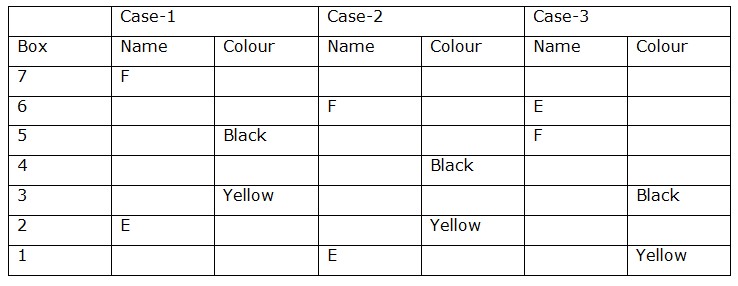 As many boxes kept above box E as below the box with Blue which is kept two boxes away from box D. Box G with white is kept at an odd numbered position.
 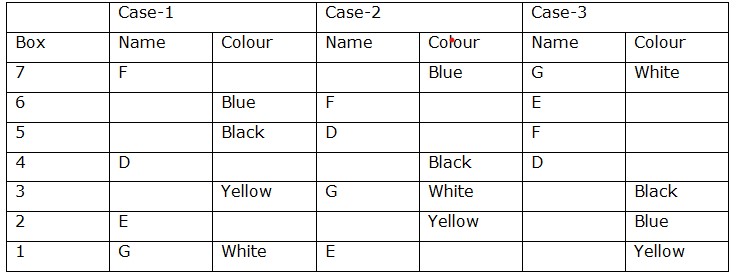 Box C is kept immediately above the box with red and two boxes below box B. The box with pink is kept immediately below the box with green. Hence, cases 1 and 3 get eliminated.
 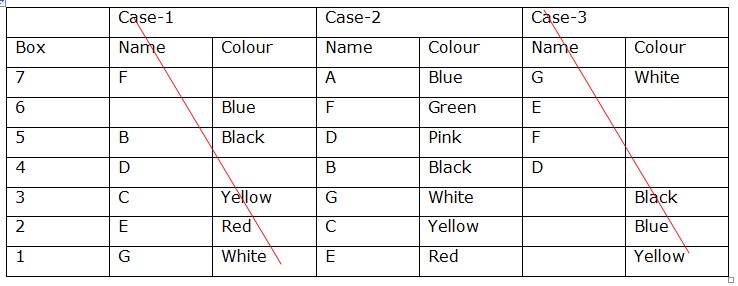 So final arrangement-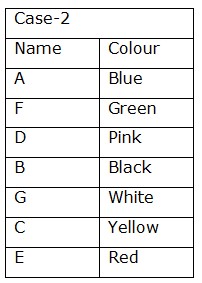
More Puzzles Questions
- If Q is related to Green and N is related to Blue. Following the similar pattern, P is related to?
- What is the distance between the one who likes 7 and P?
- Which of the following statements is/are true according to the given information?
- Five subjects Reasoning, Math, GK, Science and English (not necessarily in the same order) are taught from Monday to Friday. Only one subject is taught in ...
- Statements: Z ≤ Y < E < I; O > P > V > Q = I; Conclusions: I) Y > O II) Q > Z
- Which of the following fruit does S like?
- Who among the following persons is/ are living in Flat A? I) A II) B III) H IV) F
- Find the odd out of all the five?
- Study the information and answer the given questions: Eight persons live on different floors in the same building. The building has eight floors ground ...
- Which of the following is correct with respect to the given puzzle?
Relevant for Exams:
Hey! Ask a query
Please enter email id
The email must be a valid email address.
Please enter Mobile Number
Please enter valid Mobile Number
Please enter your Doubt

Think You're Ready for RBI Grade B?
RBI Grade B 2026 Phase 1 Memory Based Paper
- 200 Questions with Detailed Solutions
- Section-wise Coverage (GA, English, Quant & Reasoning)