


Question
Who among the following is second oldest?
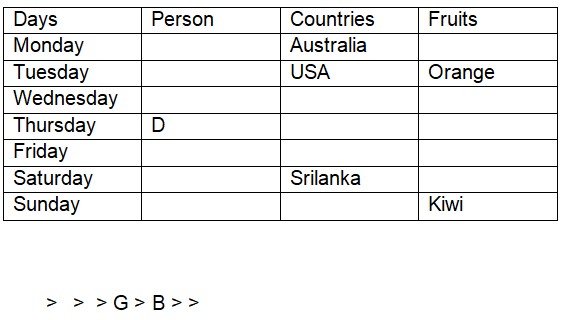 A is older than both C and F but not the oldest. Neither E nor F is youngest. D visits the country on Thursday and is just older than E. So it is clear that D is the oldest and E will be 2nd oldest and C will be the youngest. The one who visits Germany is sixth youngest. The one who visits Japan and likes guava, visits it immediately after the one who visits USA. The one who is sixth oldest visits North Korea but not on Friday.
 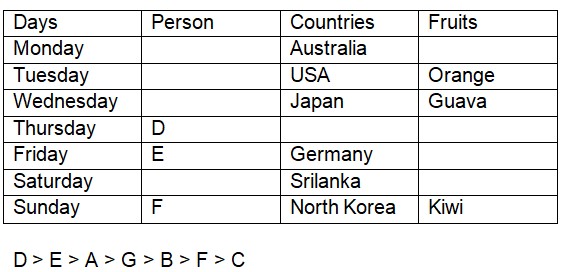 One who likes banana visits immediately after the one who likes apple but not on Friday. The one who is youngest likes mango but not immediately after E. G neither visits Srilanka nor Japan. A likes guava.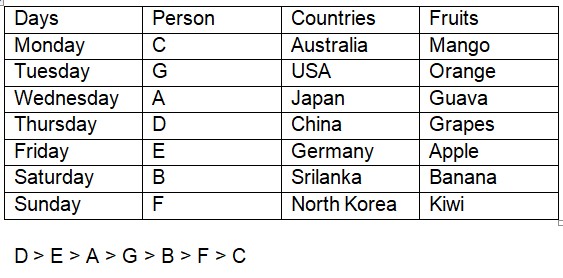
More Puzzles Questions
- Six boxes are kept one above the other, such that the box which is at the bottommost position is numbered as 1, the box above it is numbered as 2 and so on...
- Who among the following person visits immediately after X?
- What is the position of R with respect to T?
- How many members are there in Anmol’s family?
- Who among the following attends the music class immediately after the one who has tuition in Ashok nagar?
- If in a certain way ‘ACER’ is related to ‘Maruti’, ASUS is related to ‘BMW’ in the same way ‘Samsung’ is related to who among the following?
- Which of the following Flat is vacant?
- How many persons goes before U?
- How many persons live between Deepa and Chand?
- Which of the following contains Grapes?
Hey! Ask a query
Please enter email id
The email must be a valid email address.
Please enter Mobile Number
Please enter valid Mobile Number
Please enter your Doubt

Think You're Ready for RBI Grade B?
RBI Grade B 2026 Phase 1 Memory Based Paper
- 200 Questions with Detailed Solutions
- Section-wise Coverage (GA, English, Quant & Reasoning)