


Question
How many persons visits after the one who visits Bilaspur?
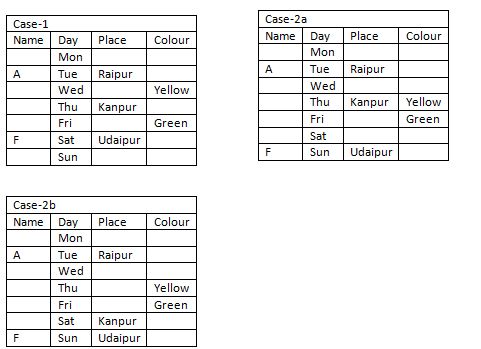 Again, we have: C neither visits on adjacent day of the one has Yellow nor on adjacent day of F. One person visits between the one who visits Bilaspur and C, who has Red, that means C visits on Monday. There were three days gap between the one who has Pink and the one who visits Bilaspur. G neither has Pink nor he visits before the one who visits Kanpur and he visits Rudrapur. There were two days gap between G and the one who likes White, who visits on adjacent day of the one who has Yellow, that means case (2b) is not valid, in case (1) G visits on Friday, in case (2a) G visits on Saturday.
 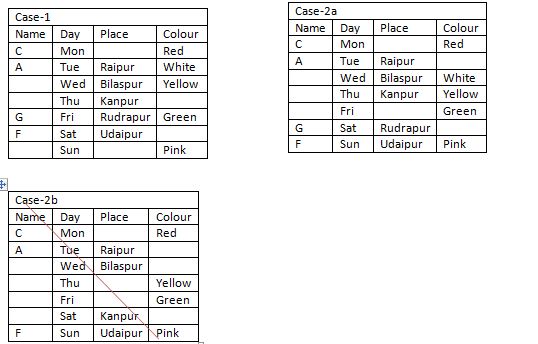 Case (2b) is not valid as G doesn’t visit before the one who visits Kanpur. Again, we have: The one who has BLACK and D visits on adjacent days. There were three days gap between D and the one who visits Jaipur, that means in case (1) D visits on Wednesday, in case (2) D visits on Friday. Neither D nor B visits Jaipur, that means in case (1) B visits Kanpur. At least three person visits between the one, who visits Rampur and the one, who has Blue, that means case (2a) is not valid. Based on above given information we have final arrangement we have: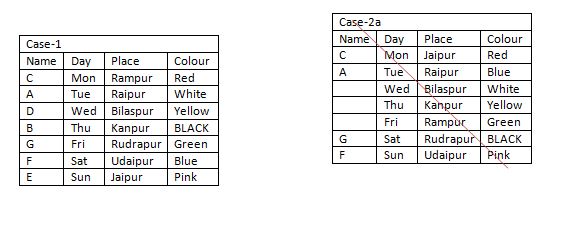
More Puzzles Questions
- Who among the following person likes Bangalore?
- Which of the following combination is correct ?
- Which of the following combinations is correct?
- Who among the following lives immediately above F who lives in the same type of flat as F?
- What is the code for the word “Purpose”?
- In the question, assuming the given statements to be true, find which of the conclusion (s) among given two conclusions is /are definitely true and then gi...
- Which of the following combinations of person – city – destination is correct?
- Who among the following persons visit on Saturday?
- Who lives two floors below X (same flat type)?
- How many persons purchased bungalow between Babli and Farun?
Relevant for Exams:
Hey! Ask a query
Please enter email id
The email must be a valid email address.
Please enter Mobile Number
Please enter valid Mobile Number
Please enter your Doubt

Think You're Ready for RBI Grade B?
RBI Grade B 2026 Phase 1 Memory Based Paper
- 200 Questions with Detailed Solutions
- Section-wise Coverage (GA, English, Quant & Reasoning)