


Question
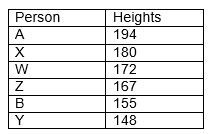
There are six persons viz. W, X, Y, Z, A and B; all are of different heights but not necessarily in the same order. X’s height is 180 cm and he is taller than W, whose height is 172 cm but shorter than A, whose height is 194
There are six persons viz. W, X, Y, Z, A and B; all are of different heights but not necessarily in the same order. X’s height is 180 cm and he is taller than W, whose height is 172 cm but shorter than A, whose height is 194
cm. B’s height is 155 cm and he is taller than Y, whose height is 148 cm but shorter than Z, whose height is 167
cm. W is taller than Z. Who is the shortest among all?
More Previous year papers Questions
- Arrange the given words in the sequence in which they occur in the dictionary. 1. DAKOTA 2. DAMAGE 3. DARKLE 4. DONKEY 5. DANCER
- Select the Venn diagram that best illustrates the relationship between the following classes. Pens, Books, Erasers
- Select the correct combination of letters from the options which when placed sequentially in the blank spaces of the series given below, will complete the ...
- Some statements are given below followed by some conclusions. Taking the given statements to be true even if they seem to be at variance from commonly know...
- Three statements in this question and three related conclusions have been given to them, assuming the truth of the story of truth is to decide which conclu...
- Three of the following four options are alike in a certain way and thus form a group. Which is the option that does NOT belong to that group? (NOTE : Oper...
- D, E, F, G, H, I, J and K are sitting around a square table facing the center of the table. Some of them are sitting at the corners while some are sitting ...
- MASTER : TSAMRE :: SMILES : LIMSSE :: FLIMSY : ?
- If each of the letters of the word 'STADIUM' are re-arranged in the English alphabetical order, then the position of which letter will remain unchanged?
- In a certain code language, ‘ONLY’ is coded as ‘2648’ and ‘NICE’ is coded as ‘7534’.What is the code for ‘N’ in the given code language?
Relevant for Exams:
Hey! Ask a query
Please enter email id
The email must be a valid email address.
Please enter Mobile Number
Please enter valid Mobile Number
Please enter your Doubt

Think You're Ready for RBI Grade B?
RBI Grade B 2026 Phase 1 Memory Based Paper
- 200 Questions with Detailed Solutions
- Section-wise Coverage (GA, English, Quant & Reasoning)