


Question
The question given below consists of two statements numbered I and II below them. You have to decide whether the data provided in the statements are sufficient to answer the question. Read all the statements and give answer: Six students P, Q, R, S, T and U attend seminars on different days in a week (Monday to Saturday). Who attends the seminar on Saturday? Statement I: P attends the seminar two days before R but after Tuesday. Three students attend the seminar between R and U. S attends the seminar on Thursday. Statement II: More than three students attend the seminar after U. Two students attend the seminar between U and S. P attends the seminar on Wednesday. T attends immediately after R.
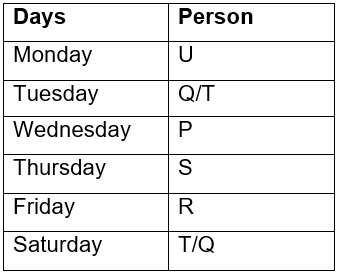 Either Q or T attends the seminar on Saturday. From statement II alone, as more than three students attend the seminar after U. Two students attend the seminar between U and S. P attends the seminar on Wednesday. T attends immediately after R. So,
 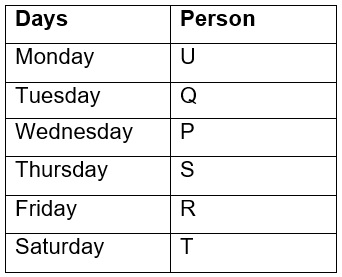 T attends the seminar on Saturday. Hence data given in statement II alone is sufficient to answer the question.
More Data Sufficiency Questions
- The question given below consists of two statements numbered I and II given below it. You have to decide whether the data provided in the statements are su...
- Eight person namely – E, F, G, H, I, J, K and L are sitting in a circular table facing centre not necessary in same order. Who sits immediate left of J? I....
- Which direction Mita is facing? Statement I: Mita started walking from point P. Statement II: She took two consecutive right turns.
- Certain number of persons are sitting in a row facing north. Who among the following sits immediate right of R? I. Only three persons sit between P and S w...
- The question given below consists of two statements numbered I and II given below it. You have to decide whether the data provided in the statements are su...
- Which date in the month of July is definitely Harish mother’s birthday? I. Harish correctly remembers that his mother’s birthday is after 15th but before ...
- Is P the mother of R? I. O is the father of Q and R. N has only one brother O. P is sister-in-law of N. N is unmarried. M is mother of N. M has only two c...
- Who among P, Q, R, S and T is tallest? I. S is taller than only 2 people and R is taller than P. II. P is not shorter than S.
- The question given below consists of two statements numbered I and II given below it. You have to decide whether the data provided in the statements are su...
- The question given below consists of three statements numbered I, II and III given below it. Read all the statements and give answer. Seven persons (L, M...
Hey! Ask a query
Please enter email id
The email must be a valid email address.
Please enter Mobile Number
Please enter valid Mobile Number
Please enter your Doubt

Think You're Ready for RBI Grade B?
RBI Grade B 2026 Phase 1 Memory Based Paper
- 200 Questions with Detailed Solutions
- Section-wise Coverage (GA, English, Quant & Reasoning)