
Question
Six persons U, V, W, X, Y and Z live on six different
floors of a six storeyed building such that bottommost floor is numbered as 1, the floor immediately above it is numbered as 2 and so on. Each person works in a different companies among J, K, L, M, N and O, however not necessarily in the same order. Who works in M?Statement I: The one, who works in L lives two floors above Y. Only two persons live between Y and the one, who works in O. W, who works in N lives immediate above the one, who works in O. The one, who works in J lives below W. Z lives two floors below the one, who works in J. V lives above the one, who works in K. Statement II: U lives on 3 rd floor. Only one person lives between U and X. The one, who works in N lives immediately above X. Only two persons live between the one, who works in J and the one, who works in N. Z lives two floors below the one, who works in J. V works in L. The one, who works in K lives below V. The question given below consists of two statements numbered I and II given below it. You have to decide whether the data provided in the statements are sufficient to answer the question. Read all the statements and answer the question.Solution
From statement I alone, The one, who works in L lives two floors above Y. Only two persons live between Y and the one, who works in O. W, who works in N lives immediate above the one, who works in O. The one, who works in J lives below W. Z lives two floors below the one, who works in J. V lives above the one, who works in K. We get: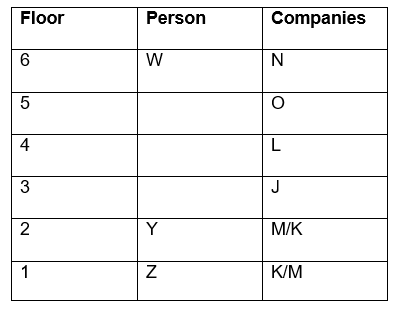
So, from statement I alone, we cannot answer who works in M. So, data given in statement I alone is not sufficient to answer the question.
From statement II alone, U lives on 3 rd floor. Only one person lives between U and X. The one, who works in N lives immediately above X. Only two persons live between the one, who works in J and the one, who works in N. Z lives two floors below the one, who works in J. V works in L. The one, who works in K lives below V. We get:
Case 1: V and L live on 4 th floor.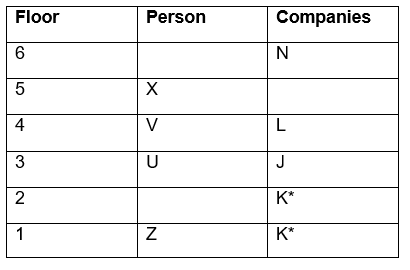
Case 2: V and L live on 2 nd floor.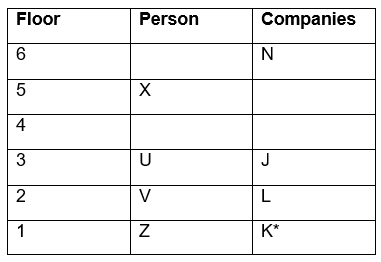
So, from statement II alone, we cannot answer who works in M. So, data given in statement II alone is not sufficient to answer the question. From statement I and II together, we get: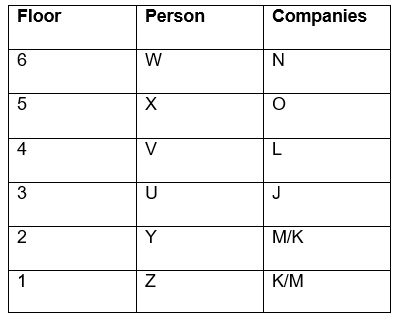
So, from statement I and II together we cannot answer who works in M.
The law of demand is based on the assumption that people will:
Recently Mastercard has appointed who among the following as its Brand Ambassador/Ambassadors ?
Fith five year plan is based on which of the following model
Investment and savings are kept equal through changes in which of the following?
Which one of the following pairs is correctly matched?
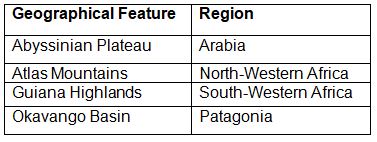
In the Monetary Policy Review on February 8, 2017, RBI did not change which of the following key rates?
The purchase of shares and bonds of Indian companies by Foreign Institutional Investors is called
Which of the following is not an investment expenditure in goods and services?
Which one of the following is the most appropriate measure of country’s economic Growth?
The terms 'Micro Economics' and "Macro Economics" were coined by
Relevant for Exams:


