


Question
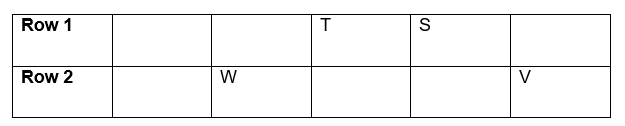
Ten persons sit in two parallel rows
Ten persons sit in two parallel rows
i.e., row I and row
II. Five persons P, Q, R, S and T sit in row
I. Five persons U, V, W, X and Y sit in row
II. The person in row I face towards the south and the persons in row II face towards the north. The person of row I face the person of row
II. Row I is to the north of row
II. The distance between any two adjacent persons in the row is same. Who faces Q?
Statement I: T sits second to the right of the one, who faces
V. Only two persons sit between V and W. Only one person sits between the one, who faces W and S.
Statement II: R sits 3rd to the left of the person, who faces U. U sits immediate left of Y. The one, who faces Y sits second to the left of Q. P sits second to the left of the one, who faces the one, who sits immediate right of W. V faces the one, who sits adjacent to S.


More Data Sufficiency Questions
- Among five states M, N, O, P and Q, M is in which direction with respect to N? I.M is to the west of O, which is to the south of Q. N is to the east of Q....
- B is in which direction with respect to E? I. D is 2m to the north of E. F is 1 m to the east of D. B is 2m to the south of F. II. E is to the south-west...
- The question given below consists of two statements numbered I and II given below it. You have to decide whether the data provided in the statements are su...
- Statements: M = U, U = V, V < W Conclusion: I. W > M II. W = U
- The question given below consists of two statements numbered I and II given below it. You have to decide whether the data provided in the statements are su...
- What is the position of Y in a row of seven persons? I.R stands at extreme end of the row and there is only one person between R and Q. II. W stands betw...
- A question is given, followed by two statements numbered (I) and (II). You have to decide whether the data provided in the statements is sufficient to answ...
- Six persons L, M, N, O, P and Q live on a 6 storey building. The bottommost floor is numbered 1 and the topmost floor is numbered 6. Who lives immediately ...
- The question given below consists of two statements numbered I and II given below it. You have to decide whether the data provided in the statements are su...
- The question given below consists of two statements numbered I and II given below it. You have to decide whether the data provided in the statements are su...
Relevant for Exams:
Hey! Ask a query
Please enter email id
The email must be a valid email address.
Please enter Mobile Number
Please enter valid Mobile Number
Please enter your Doubt

Think You're Ready for RBI Grade B?
RBI Grade B 2026 Phase 1 Memory Based Paper
- 200 Questions with Detailed Solutions
- Section-wise Coverage (GA, English, Quant & Reasoning)