


Question
Seven boxes viz. S, T, U, V, W, X and Y are kept one above other in the form of stack. How many boxes are kept above box W?
Seven boxes viz. S, T, U, V, W, X and Y are kept one above other in the form of stack. How many boxes are kept above box W?
I. Only two boxes are kept between box T and box
X. Only three boxes are kept above box
V. Box T and V are kept together. Only one box is kept between box W and box Y. Box S is neither kept at bottom nor adjacent to box T.
II. Box U is kept second from top. Box W is kept at any place above box Y. Only three boxes are kept between box X and box U. Box V, which is neither kept adjacent to box U nor box X, which is kept at s gap of two box from S. Box T doesn’t kept adjacent to box X but kept at any place below box S.
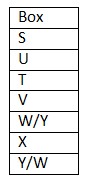 Clearly, we don’t know exact position of box W. Hence, statement I is not sufficient. From II: We have: Box U is kept second from top. Only three boxes are kept between box X and box U, that means box X is kept second from bottom. Box V, which is neither kept adjacent to box U nor box X, which is kept at s gap of two box from S, that means box V is kept fourth from bottom. Box T doesn’t kept adjacent to box X but kept at any place below box S, that means box S is kept at top. Box W is kept at any place above box Y, that means box Y is kept at bottom.
 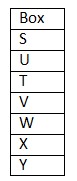 Clearly, only four boxes are kept above box W. Hence, statement II alone is sufficient.
More Data Sufficiency Questions
- Seven person namely – A, B, C, D, E, F and G are sitting in a row facing north. Each person likes different fruits viz. Banana, Mango, Papaya, Guava, Orang...
- What is the speed of the train? I. The train crosses the signal pole in 6 seconds. II. The train crosses a platform of equal length in 18 seconds. III. ...
- Among A, B, C, D and E, seated in a straight line, facing North, who sits exactly in the middle of the line? Statement I. A sits third to the left of D. B...
- Seven persons, L, M, N, O, P, Q and R goes for vacation in seven different months among January, February, March, April, May, June and July of the same yea...
- How is E related to D? I. D is the son of A’s wife who is the daughter of E’s wife. II. E’s wife is mother-in-law of D’s mother.
- The question given below consists of two statements numbered I and II given below it. You have to decide whether the data provided in the statements are su...
- S, B, T, H, M and R are sitting around a circular table. S, Band M are males while the rest are females. Who are the neighbours of S? I. T does not want a...
- Seven boxes viz. J, K, L, M, N, O and P are kept one above other. How many boxes are kept below box P? I. Box L is kept third from top. Box M and O are kep...
- How is B related to C? I. C and D are the sons of E. B is son of E’s father. II. E is sister of B and mother of D, who is brother of C.
- Jatin started from his house and walked 13m east, then he takes a left and walked 7m. Then again he takes a left and walks 8m. He finally takes right and w...
Relevant for Exams:
Hey! Ask a query
Please enter email id
The email must be a valid email address.
Please enter Mobile Number
Please enter valid Mobile Number
Please enter your Doubt

Think You're Ready for RBI Grade B?
RBI Grade B 2026 Phase 1 Memory Based Paper
- 200 Questions with Detailed Solutions
- Section-wise Coverage (GA, English, Quant & Reasoning)