


Question
A, B, C, D , E and F are sitting around a circular table facing the center. Who sits in front of C?
A, B, C, D , E and F are sitting around a circular table facing the center. Who sits in front of C?
I.A sits second to the right of F, who is second to the right of C, who is not the neighbour of
B.
II. B is second to the left of D, who is third of the left of F. C is not the neighbour of
D.
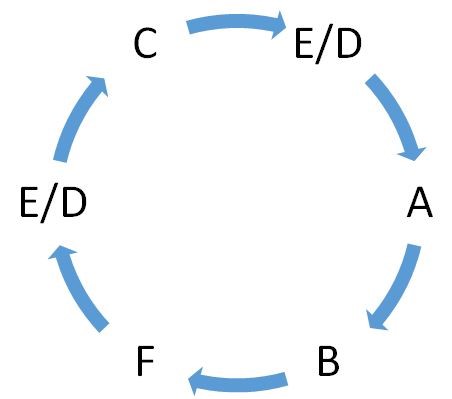 Thus B sits in front of C. From II.
 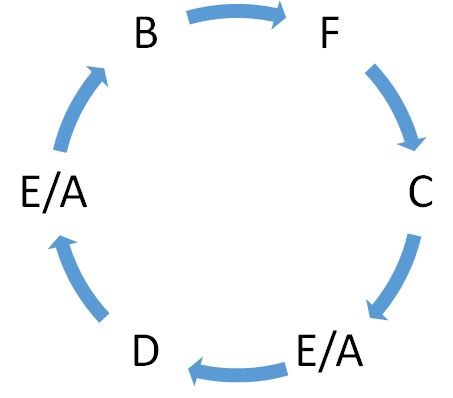 Thus either A or E sits in front of C. Hence, only statement I is sufficient to answer the question.
More Data Sufficiency Questions
- In a certain code language which of the following is the code for “trunk”? Statements: I. “trunk call given” is coded as “ck gs nc” II. “given new behalf” ...
- Which direction Mita is facing? Statement I: Mita started walking from point P. Statement II: She took two consecutive right turns.
- Among six people P, Q, R, S, T and U, each having a different marks which is 12,17,23,25,26 and 29 (marks are arranged in decreasing order from left to rig...
- Is ‘MORE’ the word formed from these four letters? I. The word starts with M. There is only one letter between E and O. II. There is only one letter betw...
- Seven persons A, B, Y, Z, M, N and G sit around a circular table facing towards the centre. Who sits immediate right of N? Statement I: G sits 2nd to the r...
- What is the code for ‘auto’ in the code language in which ‘giant segment the spot’ is written as ‘sag map pap rap’? I. In that code language ‘the auto gia...
- How is ‘since’ written in a code language? I. In a certain language ‘least inflation higher growth’ is written as ‘ka pi lm st’. II. In a certain langua...
- The question given below consists of two statements numbered I and II given below it. You have to decide whether the data provided in the statements are su...
- How is P related to G? I. P is the mother of the only brother in law of G’s sister in law. II. M is the daughter of G’s sister in law who is the only dau...
- The question given below consists of two statements numbered I and II given below it. You have to decide whether the data provided in the statements are su...
Relevant for Exams:
Hey! Ask a query
Please enter email id
The email must be a valid email address.
Please enter Mobile Number
Please enter valid Mobile Number
Please enter your Doubt

Think You're Ready for RBI Grade B?
RBI Grade B 2026 Phase 1 Memory Based Paper
- 200 Questions with Detailed Solutions
- Section-wise Coverage (GA, English, Quant & Reasoning)