


Question
Which word among the given below is following only condition II?
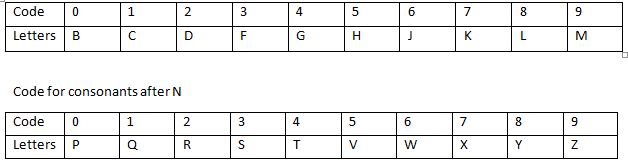 Codes for consonants before N
More Coding Decoding Questions
- In a certain code language ‘BIOLOGY’ is coded as ‘YTROLLB’ then, what is the code for ‘OPERATION’ in the same code language?
- In a certain code language, ‘TUMBLER’ is written as ‘22 – 23 – 15 – 4 – 14 – 7 – 20’. How will ‘SCIENCE’ be written in that code language?
- In a certain code language, 'resting room hotel hospitality' is coded as 'cg, nm, wq, sd', 'manager hospitality room' is coded as 'wq, sd, ot' and 'nature ...
- In a certain code language, ‘APPROVE’ is written as ‘ETTVSZI’ and ‘SUSPEND’ is written as ‘WYWTIRH’. How will ‘TENSION’ be written in that language?
- In a certain code language, 'ALIVE' is coded as 64 and 'HALL' is coded as 45. How will 'MOVIE' be coded in that language?
- In a certain code ‘RAIN’ is written as ‘10’ likewise ‘SEAT’ as ‘6’.How will you code ‘FOUR’ using the same coding logic?
- In a certain code language, da ws bv means 'lunch evening breakfast', ws xc sw means 'evening dinner afternoon' and hj da xc means 'breakfast dinner mornin...
- What is the code for ‘spread you’ in the given code language?
- In a code language, ‘BRIDGE' is coded as '31', 'STADIUM' is coded as '56'. What is the code for 'JOURNEY' in that code language?
- If ‘Maths’ is called as ‘Science’, ‘Science’ is called as ‘History’, and ‘History’ is called as ‘Geography’, then, which subject deals with numbers and cal...
Hey! Ask a query
Please enter email id
The email must be a valid email address.
Please enter Mobile Number
Please enter valid Mobile Number
Please enter your Doubt

Think You're Ready for RBI Grade B?
RBI Grade B 2026 Phase 1 Memory Based Paper
- 200 Questions with Detailed Solutions
- Section-wise Coverage (GA, English, Quant & Reasoning)