


Question
Who among the following sits at extreme end of the row?
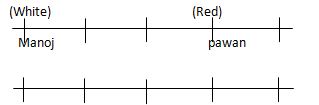 CASE-2
 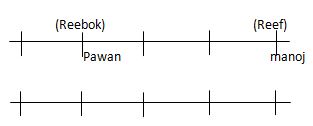 (ii)- Gautam likes yellow and sits one of the extreme end of the row. jenny sits third to the left of fareen. jenny neither likes cream nor brown (from all these conditions case1 will be eliminated and in case2- gautam sits at the extreme left end of the row then jenny sits to its immediate right and fareen at the right end of the row). the one who likes cream sits diagonally opposite to the one who likes brown. now in case2, there will be two possible cases, case-2(a) and case2 (b); as shown below: case 2(a)
  iii)- Heera is not an immediate neighbour of the one who likes cream. only two persons sit between the one who likes cream and the one who likes pink. the one who likes pink is not an immediate neighbour of manoj (from this case2 (a) will be eliminated). qasim sits third to the right of the one who likes black (qasim likes brown is fixed). the one who likes green faces north (thus it is fixed in row-2). now, the one who likes purple faces the person who likes blue. the one who likes blue faces the one who sits immediate right of the one who likes black (from this it is clear that the one who likes black faces the one who likes green). karan doesn’t face naman (thus karan faces ankit). the final arrangement will be: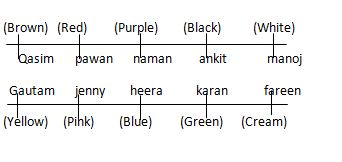
More Analytical Reasoning Questions
- Two statements are given below and they are labelled as Assertion (A) and Reason (R). Assertion (A): River Narmada flows eastward. Reason (R): Narmada Rive...
- Read the given statements and conclusions carefully. Assuming that the information given in the statements is true, even if it appears to be at variance wi...
- In a certain code language, 'missile army soldier' is written as 'cf rt nm'; 'army operation successful' is written as 'rt xc vg' and 'colonel missile visi...
- In the word ‘MEASUREMENT’ all consonants are written as their preceding letter and all vowels are written as their following letters. Now all letters are a...
- If Hrithik is related to LIFETOUCH - Brown in the same way as Varun is related to Dream photo - Purple . Following the same pattern, find out Amitabh is re...
- How many triangles are there in the given figure?
- Find the missing number in the diagram given below.
- Select the combination of letters that when sequentially placed in the blanks of the given letter series will complete the series. s _ _ _ t u _ _ t u v w...
- Statements: P ≥ Q > R, U ≤ T ≤ S = R, X ≤ W ≤ V = U Conclusion: I. R ≥ W II. W = U
- In a certain code language, 'COUNTRY' is written as ‘3-15-21-14-20-18-25 and ‘PEOPLE’ is written as 16-5-15-16-12-5. How will 'HIGHWAY' be written in that ...
Hey! Ask a query
Please enter email id
The email must be a valid email address.
Please enter Mobile Number
Please enter valid Mobile Number
Please enter your Doubt

Think You're Ready for RBI Grade B?
RBI Grade B 2026 Phase 1 Memory Based Paper
- 200 Questions with Detailed Solutions
- Section-wise Coverage (GA, English, Quant & Reasoning)