


Question
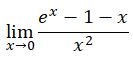 \ As x→0, the numerator approaches e0 − 1 − 0 = 1 – 1 – 0 = 0, and the denominator approaches 02 = 0. So, we have an indeterminate form of type 0/0and we can use L'Hôpital's Rule. Applying L'Hôpital's Rule once:
 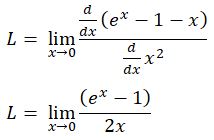 As x→0, the numerator approaches e0 −1 = 1 – 1 = 0, and the denominator approaches 2(0)=0. We still have an indeterminate form of type 0/0, so we apply L'Hôpital's Rule again. Applying L'Hôpital's Rule a second time: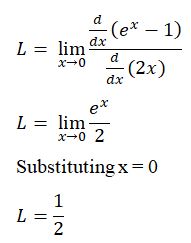
More Quant Miscellaneous Questions
- The inequality | 2x – 3 | < 5 is satisfied for:
- 'R' invested Rs. 24,000 in SIP 'A' with a compound interest rate of 20% per annum compounded annually, and Rs. 18,600 in SIP 'B' with a simple interest rat...
- Let f(x) = (3x–4)/(2x+1). Solve f(f(x)) = x.
- What is the purpose of a "Page Table" in virtual memory systems?
- The average of 5 numbers is 42. When one of the numbers is excluded, the average of the remaining four numbers becomes 38. Determine the value of the numbe...
- What is the least number of square tiles required to pave the floor of a room 11 m 47 cm long and 6 m 82 cm broad?
- Below given are 2 wrong number series. Series I: 19, 30, 6, 45, – 11, 67 Series II: 141, 148, 223, 398, 723, 1248 I. The absolute difference between the...
- What will be come in place of (?) in the given number series. 2, 3, 5, 7, 11, ?, 17
- A parallelogram has diagonals of lengths 24 cm and 18 cm. The angle between the diagonals is 60°. Find the area of the parallelogram.
- Statement: “Should the government impose higher road tax on diesel cars to reduce air pollution?” Arguments: I. Yes, because higher tax will discourage p...
Relevant for Exams:
Hey! Ask a query
Please enter email id
The email must be a valid email address.
Please enter Mobile Number
Please enter valid Mobile Number
Please enter your Doubt

Think You're Ready for RBI Grade B?
RBI Grade B 2026 Phase 1 Memory Based Paper
- 200 Questions with Detailed Solutions
- Section-wise Coverage (GA, English, Quant & Reasoning)