


Question
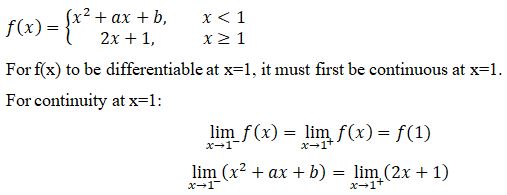 (1)2 + a(1) + b = 2(1) +1 1 + a + b = 3 a + b = 2 Now, for differentiability at x=1, the left-hand derivative must be equal to the right-hand derivative. The derivative of x2 + ax + b is 2x + a. The derivative of 2x+1 is 2. Left-hand derivative at x=1:
 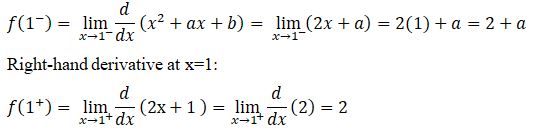 For differentiability, f′(1-) = f′(1+): 2+a=2 a=0 Now substitute the value of a into the continuity equation a + b = 2 0+ b=2 b=2 So, the values of a and b are a=0 and b=2. Therefore, (a,b)=(0,2).
 More Quant Miscellaneous Questions
- If CIRCLE coded as LZSBGJ and SQUARE is coded as TPVZGP, then what is the code for CUBOID?
- If a relation R on the set of integers Z is defined as a R b ⇔ a - b ∈ Q, then the relation is:
- Marked price of an article is Rs. M, as it is marked by a certain price. Find the value of M. Statement I. If the shopkeeper gives a discount of 10%, so, t...
- A seller sells an item for Rs. 225.50 and incurs a loss of 18%. At what price should the item be sold in order to achieve a profit of 12%?
- Question 5
- Tarun and Saurabh together can complete a task in 10 days. Tarun and Reena together can finish the same task in 14 days. Reena and Saurabh together can com...
- Rationalize the denominator and simplify:
- One-fifth of a number is equal to two-fifths of 25% of another number. Determine the ratio of the two numbers.
- Find the greatest 3-digit number which when divided by 11 or 14 leaves a remainder of 3.
- I. x ² – 10x + 21 = 0 II. y ² – 8y + 15 = 0
Relevant for Exams:
Hey! Ask a query
Please enter email id
The email must be a valid email address.
Please enter Mobile Number
Please enter valid Mobile Number
Please enter your Doubt

Think You're Ready for RBI Grade B?
RBI Grade B 2026 Phase 1 Memory Based Paper
- 200 Questions with Detailed Solutions
- Section-wise Coverage (GA, English, Quant & Reasoning)