


Question
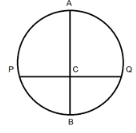
AB is the diameter of a circle with centre 'O'. PQ is a chord that cuts AB at 'C'. If radius of the circle is 7.5 cm and AC:CB = 3:2, the find the length of PQ, given that PC ⊥ AB.
More Geometry Questions
- In the figure given below, AC = 16 cm and BF = 5 cm. If AE:CE = 5:3, then find the perimeter of ΔABC.
- In ∆ABC , G is the centroid , AB = 8 cm, BC= 12 cm and AC = 14 cm , find GD, where D is the mid-point of BC?
- In triangle ABC, the sides are AB = 13 cm, BC = 14 cm, and CA = 15 cm. What is the length of the altitude from vertex A to side BC?
- In the given figure. ABCDEF is a regular hexagon whose side is 6 cm. APF, QAB, DCR and DES are equilateral triangles. What is the area (in cm2) of the shad...
- ABC is a right angled triangle. ∠ BAC = 90o and ∠ ACB = 60o. What is the ratio of the circum radius of the triangle to the side AB?
- If I is the incentre of ΔABC , if ∠ BIC = 1200 , then what is the measure of ∠ BAC?
- Length of a chord in a circle of radius 'r' cm, is 14 cm and distance between chord and centre of the circle is 24 cm. Find the value of (4r - 60).
- Question 8
- Question 9
- In ∆ABC , G is the centroid , AB = 18 cm, BC= 24 cm and AC = 30 cm , find GD, where D is the mid-point of BC?
Hey! Ask a query
Please enter email id
The email must be a valid email address.
Please enter Mobile Number
Please enter valid Mobile Number
Please enter your Doubt

Think You're Ready for RBI Grade B?
RBI Grade B 2026 Phase 1 Memory Based Paper
- 200 Questions with Detailed Solutions
- Section-wise Coverage (GA, English, Quant & Reasoning)