


Question
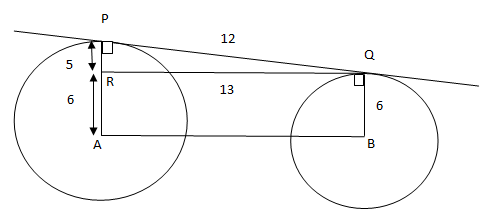
A and B are the centres of two circles with radii 11 cm and 6 cm respectively. A common tangent touches these circles at P & Q respectively. If AB =13 cm, then the length of PQ is
More Geometry Questions
- Angles of a triangle are in the ratio 5 : 6 : 7. Find the measure of the smallest angle.
- If O is circumcentre of acute angled triangle ABC, if ∠ BOC = 150˚ then ∠ BAC = ?
- Determine the difference between an angle and its complementary angle, given that the angle is two-thirds of its complement.
- Question 4
- The sides of a triangle are 10 cm, 17 cm, and 21 cm. Find the area of the triangle using Heron’s formula.
- The area of an equilateral triangle is 4√3 sq m. Its perimeter is
- The radius of the incircle of a triangle is 6 cm. if the area of the triangle is 30 cm 2 , then its perimeter is?
- What will be inradius of an equilateral triangle of side 2 cm?
- Let A, B, and C be the mid-points of sides PQ, and QR PR, respectively, of ΔPQR. If the area of ΔPQR is 64cm², then find the area of ΔABC.
- ABCD is a cyclic quadrilateral, such that ratio of measures ∠A, ∠B and ∠C is 1 : 4 : 5, then the measure of ∠D is?
Hey! Ask a query
Please enter email id
The email must be a valid email address.
Please enter Mobile Number
Please enter valid Mobile Number
Please enter your Doubt

Think You're Ready for RBI Grade B?
RBI Grade B 2026 Phase 1 Memory Based Paper
- 200 Questions with Detailed Solutions
- Section-wise Coverage (GA, English, Quant & Reasoning)