


Question
In the given figure, Ab = 30 cm and CD = 24
In the given figure, Ab = 30 cm and CD = 24
cm. What is the value (in cm) of MN?
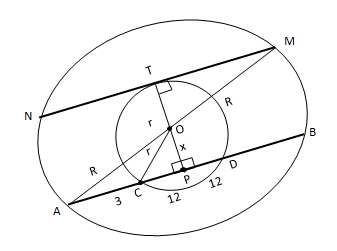 If we draw a perpendicular to a chord of any circle, the per divide the chord in two equal part. CD is chord for small circle and AB is chord for bigger circle. r = small circle radius R = bigger circle radius Apply PGT in ∆ OTC x2 = (x)2 – (12)2 ---- (1) Apply PGT in ∆ OAP x2 = (R)2 – (15)2 ------(2) From (1) and (2) R2 – (15)2 = r2 – (12)2 R2 – r2 = 225 – 114 = 81 Apply PGT in ∆ OTM R2 – r2 = TM2 81 = TM2 TM = 9 We know OT divide chord MN in 2 equal part (TM = TN) MN = TM + TN MN = 9 + 9 = 18
More Geometry Questions
- If median AD of an equilateral ∆ABC is 6 cm and G is centroid. Find AG?
- If I is the incentre of ΔABC , if ∠ BIC = 1300 , then what is the measure of ∠ BAC?
- The lengths of three medians in a triangles are 6 cm, 8 cm, 10 cm. What is the area of that traingle (in cm 2 )?
- The length of the each side of an equilateral triangle is 21. The area of incircle, (cm 2 ) is
- What will be inradius of a right angle triangle whose base is 15cm & height is 8cm ?
- If I is the incentre of ΔABC , if ∠ BAC = 450 , then what is the measure of ∠ BIC?
- In the given figure, PQR is a triangle and quadrilateral ABCD is inscribed in it. QD = 2 cm, QC = 5 cm, CR = 3 cm. BR = 4 cm. PB = 6 cm. PA = 5 cm and AD =...
- The length of the each side of an equilateral triangle is 14√3. The area of incircle, (cm 2 ) is
- If G is the centroid and AD, BE, CF are three medians of ∆ABC with area 42 cm 2 , then the area of ∆BGD is?
- If in a ΔABC, AD is internal angle bisector & D is a point on BC, AB = 6cm, BC = 9cm then what is BD:CD?
Relevant for Exams:
Hey! Ask a query
Please enter email id
The email must be a valid email address.
Please enter Mobile Number
Please enter valid Mobile Number
Please enter your Doubt

Think You're Ready for RBI Grade B?
RBI Grade B 2026 Phase 1 Memory Based Paper
- 200 Questions with Detailed Solutions
- Section-wise Coverage (GA, English, Quant & Reasoning)