


Question
What is the total number of Astronauts who were going to MOON?
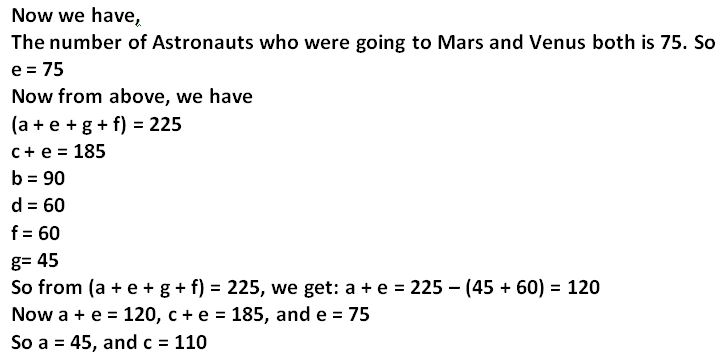
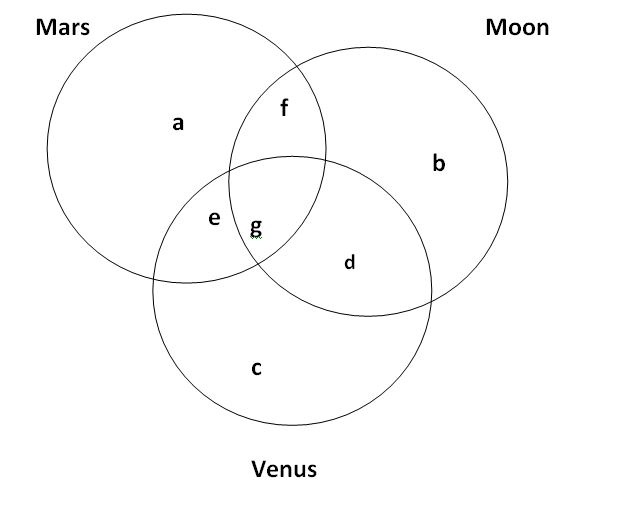 Number of Astronauts who were goint to Mars is 225 so (a+e+g+f) = 225 of which 26(2/3)% Astronauts were going only on mars and moon so f = 26 (2/3)% of 225 = 60 the number of astronauts who were going to both moon and venus are 33(1/3)% greator than those who were going to all the three missions, so d is 33(1/3)% greator than g the number of astronauts who were going to venus but not moon is 185. so c + e = 185 (means venus and mars)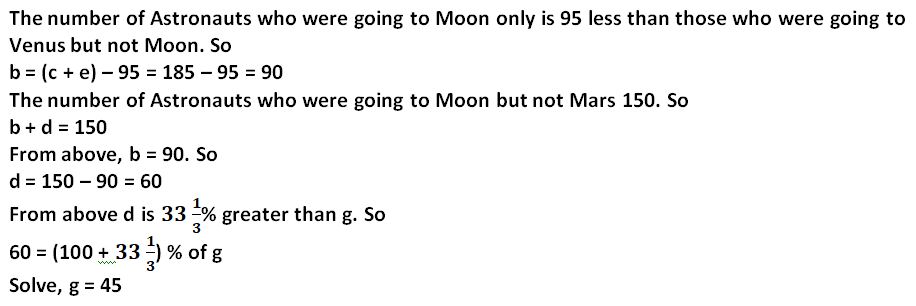
More Databased Questions
- If the cost of 3AC class ticket of train Q is Rs. 1520 for any two stations, find the total revenue earned by train Q from 3 AC coaches.
- What is the number of Astronauts who were going to both Mars and Moon only?
- What is the ratio between Astronauts who were going to only Venus and who were going only to both Moon and Venus?
- Suppose that the reliability of a COVID test is specified as follows: Of people having COVID, 90% of the test detect the disease but 10% go undetected. Of...
- The number of passengers travelling in sleeper class of train Q is approximately what percent of the number of passengers of both train P and train Q toget...
- Supporters of Mumbai in the crowd finally is approximately what percent of the initial number of supporters of Pune in the beginning at 8.00 pm?
- What is the difference between the Mumbai and Pune supporters after the match was restarted?
- How many nuclear bombs Russia had initially?
- Supporters of Pune in the crowd finally is approximately how much percent less or more than the number of Pune supporters who left after the match was dela...
- What would have been ratio of the supporters of Mumbai and Pune at 10.00 pm initially before the new arrivals, if those 30% of the supporters came back wer...
Relevant for Exams:
Hey! Ask a query
Please enter email id
The email must be a valid email address.
Please enter Mobile Number
Please enter valid Mobile Number
Please enter your Doubt

Think You're Ready for RBI Grade B?
RBI Grade B 2026 Phase 1 Memory Based Paper
- 200 Questions with Detailed Solutions
- Section-wise Coverage (GA, English, Quant & Reasoning)