
📢 Too many exams? Don’t know which one suits you best? Book Your Free Expert 👉 call Now!


    Question

    A Public Limited Company intends to further its capital

    structure. According to the provisions of the Companies Act, 2013, which of the following statements correctly identifies the legal restriction regarding the 'Subscribed Capital' and 'Paid-up Capital' during a rights issue or private placement?"
    A A company can issue shares at a discount to increase its Subscribed Capital, provided it is authorized by a special resolution and approved by the NCLT. Correct Answer Incorrect Answer
    B Any 'Called-up Capital' that remains unpaid for more than six months automatically ceases to be part of the Subscribed Capital and is moved to 'Forfeited Accounts' by operation of law. Correct Answer Incorrect Answer
    C Subscribed Capital can exceed the Authorized Capital of the company if the Board of Directors passes a resolution to 'Capitalize Reserves' without amending the Memorandum of Association. Correct Answer Incorrect Answer
    D For the purpose of determining the 'voting power' of a shareholder in a poll, the calculation is based on the proportion of the Paid-up equity share capital held by them, not the Subscribed Capital. Correct Answer Incorrect Answer
    E Under Section 62, a company must ensure that its Subscribed Capital is 100% Paid-up before it can offer further shares to its existing employees under an ESOP scheme. Correct Answer Incorrect Answer

    Solution

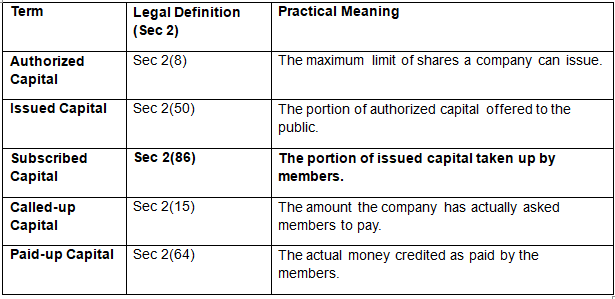
    Detailed Explanation: 1.    Voting Rights Principle: Under Section 47 of the Companies Act, 2013 , every member of a company limited by shares holding equity shares has a right to vote on every resolution. However, their voting right on a poll is in proportion to their share in the Paid-up equity share capital of the company. 2.    Why B is the Answer: In legal practice, there is often a gap between what is "Subscribed" and what is "Paid-up" (due to calls-in-arrears). The law links the power of the vote to the actual money brought into the company (Paid-up), not just the promise to pay (Subscribed). 3.    Why A is incorrect: Section 53 strictly prohibits the issue of shares at a discount (except for Sweat Equity shares), and NCLT cannot authorize a general discount issue. 4.    Why C is incorrect: The Subscribed Capital can never exceed the Authorized Capital. The Authorized Capital is the maximum ceiling mentioned in the Capital Clause of the Memorandum of Association (MoA). To increase it, the MoA must be amended under Section 61. Summary Table: The Capital Ladder

    Practice Next
    ask-question
