Question
A Public Limited Company intends to further its capital
structure. According to the provisions of the Companies Act, 2013, which of the following statements correctly identifies the legal restriction regarding the 'Subscribed Capital' and 'Paid-up Capital' during a rights issue or private placement?"Solution
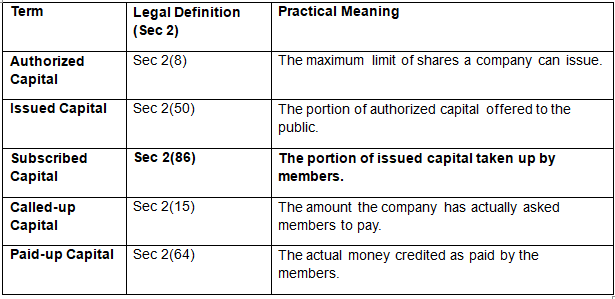
Detailed Explanation: 1.   Voting Rights Principle: Under Section 47 of the Companies Act, 2013 , every member of a company limited by shares holding equity shares has a right to vote on every resolution. However, their voting right on a poll is in proportion to their share in the Paid-up equity share capital of the company. 2.   Why B is the Answer: In legal practice, there is often a gap between what is "Subscribed" and what is "Paid-up" (due to calls-in-arrears). The law links the power of the vote to the actual money brought into the company (Paid-up), not just the promise to pay (Subscribed). 3.   Why A is incorrect: Section 53 strictly prohibits the issue of shares at a discount (except for Sweat Equity shares), and NCLT cannot authorize a general discount issue. 4.   Why C is incorrect: The Subscribed Capital can never exceed the Authorized Capital. The Authorized Capital is the maximum ceiling mentioned in the Capital Clause of the Memorandum of Association (MoA). To increase it, the MoA must be amended under Section 61. Summary Table: The Capital Ladder
Aman, Bhanu, and Chikku jointly initiated a business with a total investment of Rs. 80,000, of which Aman invested Rs. 24,000. After 6 months, Aman adde...
N initiates a business, and after 3 months, D also becomes a part of the business. The initial investment of N and D is in the ratio of 3:2, respectivel...
Arjun and Neha started a firm with investments of Rs.12000 and Rs.9000 respectively. Arjun invested for 8 months more than Neha. If the profit share of...
A and B together start a business with investment of Rs. 2500 and Rs. (x + 500), respectively. If the profit earned after 5 years is Rs. 8000 and share ...
‘A’ and ‘B’ started a business by investing certain sum in the ratio 6:5, respectively for 6 years. If 12% of the total profit is donated in an ...
Deepa, Eshan and Farah invest Rs. x, Rs. (x + 3000) and Rs. 5x, respectively. After 9 months, Deepa and Farah withdraw their money. If the annual profit...
Deepak, Mohit, and Sneha started a business with initial investments in the ratio 3:4:6 respectively. After one year, Sneha, Deepak, and Mohit made addi...
A, B and C enter into a partnership with a capital in which A’s contribution is Rs. 16,000. If out of a total profit of Rs. 1500, A gets Rs. 500 a...
'A' initiated a venture with an initial investment of Rs. 4000. Ten months into the business, 'B' contributed Rs. 6000, and simultaneously, 'A' added an...
In a business, two partners, B and A, made investments in the ratio of 15:16. After 5 months, P joined with an investment of Rs. ...