


Question
If Planck’s constant h, gravitational constant G, and speed of light v are taken as fundamental units, the dimension of time is:
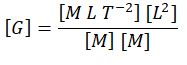 [G] = [M-1 L3 T-2] [v] (speed of light) has dimensions of length per time: [v] = [L T-1] Now, substitute these dimensions into the equation for [T]: [T] = [M L2 T-1]a [M-1 L3 T-2]b [L T-1]c [T] = [Ma L2a T-a] [M-b L3b T-2b] [Lc T-c] [T] = [Ma-b L2a+3b+c T-a-2b-c] For the dimensions to be equal on both sides, the powers of M, L, and T must be the same: For M: a − b = 0 ⟹ a = b (1) For L: 2a + 3b + c = 0 (2) For T: −a − 2b – c =1 (3) Substitute a = b from (1) into (2) and (3): From (2): 2a + 3a +c = 0 ⟹ 5a + c = 0 ⟹ c = −5a (4) From (3): −a−2a−c = 1 ⟹ −3a − c = 1 (5) Now substitute c = −5a from (4) into (5): −3a−(−5a)=1 −3a+5a=1 2a=1 a = 1/2 Since a = b, we have b=1/2. Now substitute the value of a into equation (4) to find c: c = -5a = -5/2 The dimension of time is [h1/2 G1/2 v-5/2] Therefore, the correct answer is option (C).
More Physics GS Questions
- The frequency of ultrasonic waves is:
- Find the equivalent resistance when three resistors of 4 Ω, 6 Ω, and 12 Ω are connected in parallel.
- For a non-relativistic particle, the ratio of phase velocity to group velocity of de Broglie waves is:
- What is the weight of a 10 kg object on Earth? (Take g = 9.8 m/s²)
- Which of the following materials exhibits piezoelectric effect?
- The functioning of a quartz crystal in a watch is based on which principle?
- In a refrigerator, the cooling system should always be –
- Which of the following phenomena establishes the transverse nature of light waves?
- In a plane electromagnetic wave. the electric field oscillates sinusoid ally at a frequency of 3 × 10⁸ Hz and amplitude 36 V/m. Find the amplitude of the o...
- Which law states that the total current entering a junction is equal to the total current leaving the junction?
Relevant for Exams:
Hey! Ask a query
Please enter email id
The email must be a valid email address.
Please enter Mobile Number
Please enter valid Mobile Number
Please enter your Doubt

Think You're Ready for RBI Grade B?
RBI Grade B 2026 Phase 1 Memory Based Paper
- 200 Questions with Detailed Solutions
- Section-wise Coverage (GA, English, Quant & Reasoning)