


Question
Assertion (
- A : Unity of command cannot always be strictly applied in practice. Reason (
- R : Workers should report to different supervisors for different aspects or tasks technical, financial, administrative etc.
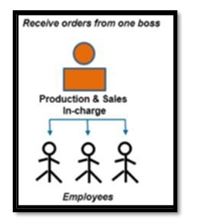 • This principle is against the Taylor’s functional foremanship where multiple superiors oversee the subordinate. As per Fayol if there is no unity of command it will lead to conflict as subordinate will never know whom to obey. Adoption of this principle leads to clarity about work whereas violation will lead to confusion about what to do and what not to do. • However, Unity of command cannot always be strictly applied in practice, because no manager has all the required skills. For example, a marketing manager will not have the knowledge regarding the work done in the production department. Therefore, if an employee of marketing employee has a doubt regarding production department, in that case, the employee is bound to visit the production manager and that is a grave violation of unity of command. Therefore, assertion is correct. • Moreover, globalization has forced the Indian companies to create multiple business divisions, and therefore workers should report to different supervisors for different aspects or tasks technical, financial, administrative etc. and that will lead to a higher specialization in the work profile of different employees. Therefore, reason is also correct. Hence the correct answer will be option A.
More ESIC Part B Questions
- Brinda starts from Point A and drives 19 km towards West. She then takes a left turn, drives 22 km, turns left and drives 25 km. She takes a final left tur...
- If day before yesterday it was Monday, then which will be the day on day after tomorrow ?
- What is the maximum pension amount payable under Pradhan Mantri Vaya Vandana Yojana (PMVVY)?
- Profit and Loss Account is prepared:
- A triangle has all three sides of length 18 cm. Determine the circumradius of this triangle.
- Which of the following is an example of a Herbicide?
- The LCM of 48, 72 and another number, x, is 576. Which of the values given below can be the value of x?
- A shopkeeper sold an article after giving a discount of 25% and made a profit of Rs.64. Find the difference between the marked price and selling price of t...
- A is twice as old as B. B is 1/3 as old as C. The sum of ages of A, B, and C is 42 years. Find the sum of the ages of A and B.
- When goods are purchased for the Joint Venture, the amount is debited to
Relevant for Exams:
Hey! Ask a query
Please enter email id
The email must be a valid email address.
Please enter Mobile Number
Please enter valid Mobile Number
Please enter your Doubt

Think You're Ready for RBI Grade B?
RBI Grade B 2026 Phase 1 Memory Based Paper
- 200 Questions with Detailed Solutions
- Section-wise Coverage (GA, English, Quant & Reasoning)