


Question
RBI has proposed to extend the BASEL-III Capital regulations to All India Financial Institutions (AIFIs) and minimum total capital against risk-weighted requirements for the same is:
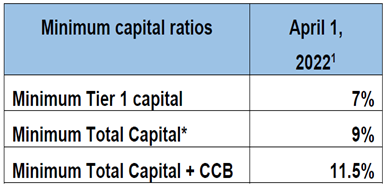 For NHB (National Housing Bank) Since the accounting year is July-June, the implementation shall commence on July 1, 2022. AIFIs are required to maintain a minimum Pillar 1 Capital to Risk-weighted Assets Ratio (CRAR) of 9% on an on-going basis (other than capital conservation buffer and countercyclical capital buffer etc.). These institutions should have minimum total capital at nine per cent from 1 April 2022 along with minimum capital buffer at 2.5 per cent, the central bank has recommended. Minimum common equity tier 1 (CET1) capital would be 5.5 per cent while minimum tier one capital requirement is proposed at seven per cent.
More Capital Market Questions
- How much equity infusion has been allocated through the Self-Reliant India Fund?
- A Foreign Portfolio Investor (FPI) needs to register in India with SEBI. A DDP grants the certificate to the FPI, on behalf of SEBI. What does DDP stand fo...
- Which of the following is not the name of the sensitive index of any stock exchange ?
- In India, Treasury bills (T-bills) are auctioned by _____
- What is the maximum award that can be imposed by the NBFC Ombudsman in India, as decided by the RBI?
- What is the settlement cycle in Indian stock market?
- What makes a Zero Coupon Zero Principal (ZCZP) instrument fundamentally different from a standard corporate bond?
- Which of the following is not a criterion for a Stock exchange whose subsidiary can be an Accreditation Agency?
- Under the framework of Market Efficiency, short selling is most accurately described as a mechanism that ________; however, proponents of the limits to arb...
- The Basel III capital regulations are based on which of mutually reinforcing Pillars
Relevant for Exams:
Hey! Ask a query
Please enter email id
The email must be a valid email address.
Please enter Mobile Number
Please enter valid Mobile Number
Please enter your Doubt

Think You're Ready for RBI Grade B?
RBI Grade B 2026 Phase 1 Memory Based Paper
- 200 Questions with Detailed Solutions
- Section-wise Coverage (GA, English, Quant & Reasoning)