


Question
In a small open economy with imperfect capital mobility, MPS = 0.25, MPM = 0.15, and interest sensitivity of capital flows φ = 0.4. A foreign country raises its interest rate by 2 percentage points. If the domestic economy maintains its interest rate unchanged, the resulting BOP position and required policy response are:
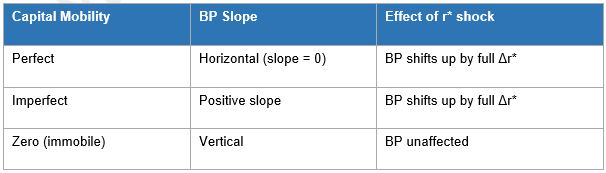 Why others are wrong:
 More Research Questions
- Which of the following is/are the aim/aims of "Digital India" Plan of the Government of India? Formation of India's own Internet companies like China di...
- A dice was rolled 3 times. What is the probability of getting 5 at least once?
- The 'Semi-Strong Form' of the Efficient Market Hypothesis (EMH) states that stock prices reflect:
- The substitution effect for a commodity is
- Zia wants to increase total revenue at his restaurant. The price elasticity of demand for several dishes that he serves are given in the table below. Pric...
- The consumption function of an economy is given by dC/dY = 0.8 − 0.004Y. Consider the following statements: (I) The MPC is constant at 0.8 (II) MPC decline...
- A competitive firm faces a total cost function given by: TC = 0.5Q² + 10Q + 50 If the market price is P = 30, what is the profit-maximising output Q*, an...
- The H.M. and G.M. of a distribution are 8 and 10 respectively. Then the A.M. is
- Consider a fractional reserve banking system with a legally required reserve-deposit ratio of m. Suppose that an individual deposits ID dollars in one bank...
- Mean salary of total 100 employees was given to be 800. Also, mean salary of male and female employees was 400 and 900 respectively. Find the percentage ...
Hey! Ask a query
Please enter email id
The email must be a valid email address.
Please enter Mobile Number
Please enter valid Mobile Number
Please enter your Doubt

Think You're Ready for RBI Grade B?
RBI Grade B 2026 Phase 1 Memory Based Paper
- 200 Questions with Detailed Solutions
- Section-wise Coverage (GA, English, Quant & Reasoning)