


Question
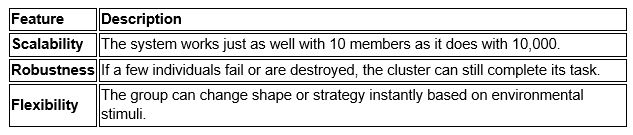
In the context of "swarm-like clusters" (Swarm Intelligence), which of the following best describes the mechanism that allows the group to exhibit complex, coordinated behavior without a central leader?
More Research Questions
- Oligopolies can end up looking like competitive markets if the number of firms is
- A profit-maximizing monopolist finds that if it remains open, the best output is 50 a week, but at this output it would make a loss. Under what circumstanc...
- What is the Standard deviation of first 50 natural numbers
- Hedonic pricing is a method used for environmental valuation that:
- According to Keynesian theory, the equilibrium level of income and output in an economy is determined by the intersection of:
- List – I List – II a. Organic Composition of Capital 1. Hirschman b. Doctrine of Natural Law 2. Schumpeter c. Inn...
- We quite often use the term economies of scale. What does this mean?
- Match the following
- The devaluation of a country’s currency will lead to an improvement in its balance of trade with the rest of the world only if
- Match the following A. Modigliani I. Liquidity Trap B. Hicks II. IS-LM C. Pigou ...
Hey! Ask a query
Please enter email id
The email must be a valid email address.
Please enter Mobile Number
Please enter valid Mobile Number
Please enter your Doubt

Think You're Ready for RBI Grade B?
RBI Grade B 2026 Phase 1 Memory Based Paper
- 200 Questions with Detailed Solutions
- Section-wise Coverage (GA, English, Quant & Reasoning)