


Question
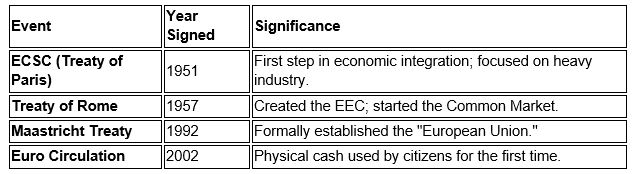
Arrange the following milestones in the history of the European Union in the correct chronological order (from earliest to most recent): I. The signing of the Maastricht Treaty. II. The establishment of the European Coal and Steel Community (ECS
- C . III. The introduction of Euro banknotes and coins into physical circulation. IV. The signing of the Treaty of Rome, establishing the European Economic Community (EE
- C .
More Research Questions
- For any given price, a firm in a competitive market will maximize profit by selecting the level of output at which price intersects the
- Autocorrelated errors is about
- Time Reversal Test is satisfied by
- According to the Romer model, if the stock of ideas increases by 15 %, how much will output per worker increase when all else is equal?
- If an OLS regression model violates the assumption of Homoscedasticity (i.e., it exhibits Heteroscedasticity), which of the following properties of the OLS...
- T he Golden Rule of Capital in the Solow Growth Model is that level of steady-state capital per worker where, I. Output per worker is...
- If a researcher finds that the variance of the error term in a regression is proportional to the square of one of the independent variables, the model suff...
- In the context of the Balance of Payments (BOP), which transaction represents an entry in the Financial Account (Capital Account) that would be recorded as...
- Question 9
- In statistics, which measure of dispersion is not affected by extreme values?
Hey! Ask a query
Please enter email id
The email must be a valid email address.
Please enter Mobile Number
Please enter valid Mobile Number
Please enter your Doubt

Think You're Ready for RBI Grade B?
RBI Grade B 2026 Phase 1 Memory Based Paper
- 200 Questions with Detailed Solutions
- Section-wise Coverage (GA, English, Quant & Reasoning)