


Question
Statements: Some tigers are lions. No lion is a leopard. Some leopards are Fox. Conclusions:I. No leopard is a tiger.
Statements: Some tigers are lions. No lion is a leopard. Some leopards are Fox. Conclusions:I. No leopard is a tiger.
II. Some tigers are leopards.
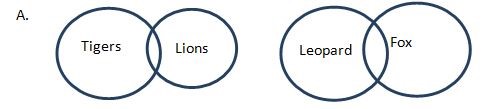
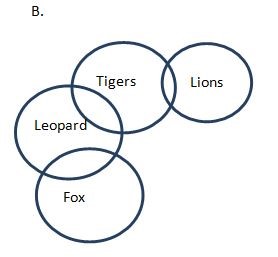
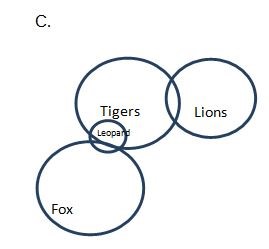 In case A, no leopard is a tiger and in case B & C some tigers are leopard. Thus, either of them is true.
 More Syllogism Questions
- Statements: All clubs are pub. No pub is a song. All songs are music. Conclusions: I. All songs being clubs is a possibility. II. No pub is a music. ...
- In each of the following question below are given some statements followed by some conclusions. Taking the given statements to be true even if they seem to...
- Statements: All sparrows are parrots. No parrot is bird. All birds are peacocks. Conclusions: I. Some birds are not parrots. II. Some peacocks are no...
- Statements: All glasses are plates. Some plates are bowls. Conclusions:I. Some bowls are glasses. II. No bowl is a glass.
- Statements: All summers are winters. Only a few summers are spring. Some springs are autumn. No autumn is season. Conclusions: I. Some winters are springs ...
- Read the given statements and conclusion carefully. Assuming the information given in the statement is true, even if it appears to be at variance with comm...
- How many Floors are in between the U and S?
- Statements: All balls are bats. Some umpires are bats. Some players are umpires. Conclusions: I. Some players are bats. II. Some umpires are balls. III. So...
- Read the given statements and conclusions carefully. Assuming that the information given in the statements is true, even if it appears to be at variance wi...
- Statements: Only a few Radio are Gramophone No Gramophone are TV Only a few TV is Recorder Conclusions: In the question below some statements are given fol...
Relevant for Exams:
Hey! Ask a query
Please enter email id
The email must be a valid email address.
Please enter Mobile Number
Please enter valid Mobile Number
Please enter your Doubt

Think You're Ready for RBI Grade B?
RBI Grade B 2026 Phase 1 Memory Based Paper
- 200 Questions with Detailed Solutions
- Section-wise Coverage (GA, English, Quant & Reasoning)