


Question
Statements: Some Letter are Coin. All Coin are Note Only a few Paper are Note. Conclusions:
Statements: Some Letter are Coin. All Coin are Note Only a few Paper are Note. Conclusions:
I. Some Letter are Note.
II. All Letter are Paper.
III. No Letter are Paper.
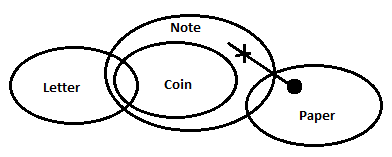 Alternate Method: Some Letter are Coin (I) + All Coin are Note (A) ⇒ Some Letter are Note (I). Hence conclusion I follows. Some Letter are Note (I) + Some note are paper (I) ⇒ No conclusion. Hence neither conclusion II nor III follows.
More Statement and conclusions Questions
- Based on the following statements, which is the correct conclusion drawn. Only gentlemen can become members of the club. Many of the members of the club ar...
- Statement: A new immigration system will be in place by March 2024 when the free movement of people between the EU and the UK ends, a UK minister has said...
- Statement: Some mad are sad. Only a few sad are bad. All bad are lad. No lad is dad. All dad are gad. Conclusions: All sad may be lad. All lad can b...
- In each question below is given a statement followed by two conclusions numbered I and II. You have to assume everything in the statement to be true, then ...
- In the question below, a situation is given, followed by two statements that may or may not be concluded from the situation. Select the option that contain...
- 1. Banana price is more than that of lychee. 2. Banana price is less than that of kiwi. 3. Kiwi Price is more than that of banana and lychee. If both, 1...
- Read the given statements and conclusions carefully. Decide which of the given conclusions is true based the given statements. Statement: Dhoni is blessed...
- In each question below is given a statement followed by two conclusions numbered I and II. You have to assume everything in the statement to be true, then ...
- Statements: No unit is measurement. Some measurements are lines. Only a few units are points. Conclusions: I. Some points are not lines. II. Some u...
- Given below are two statements, followed by two conclusions. Assume the given statements to be true even if they vary with commonly known facts. Based on t...
Relevant for Exams:
Hey! Ask a query
Please enter email id
The email must be a valid email address.
Please enter Mobile Number
Please enter valid Mobile Number
Please enter your Doubt

Think You're Ready for RBI Grade B?
RBI Grade B 2026 Phase 1 Memory Based Paper
- 200 Questions with Detailed Solutions
- Section-wise Coverage (GA, English, Quant & Reasoning)