


Question
Four of the following five are alike in a certain way and hence form a group. Who among the following person does not belong to that group?
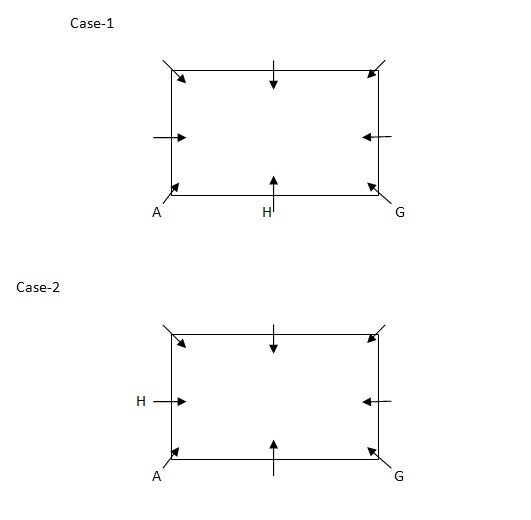 D sits opposite to the one who sits second to the left of C. C sits in the middle of the sides of table. D is neither the immediate neighbor of G nor A
 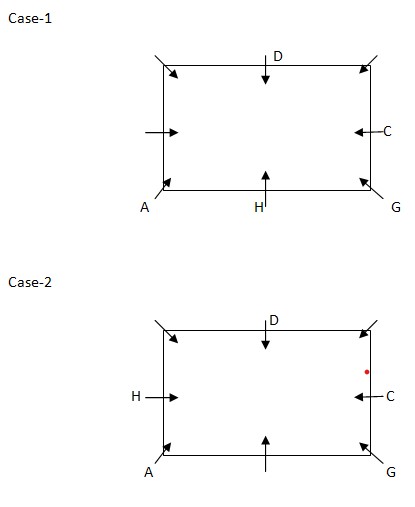 E is the immediate neighbor of either of A or F, but not the both. B sits second to the left of F. From the above condition, case1 gets eliminated. Case 2 shows the final arrangement.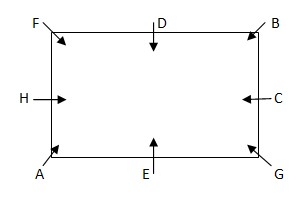
More Seating Arrangement Questions
- Six students (L, M, N, O, P and Q) sit in a linear row facing south in a classroom but not necessarily in the same order. One person sits between L and N. ...
- Four friends O, P, Q and R are sitting in a row facing south. P and Q are sitting at an extreme end of the row. O is sitting between P and R and sits seco...
- Who likes Star Maa channel?
- What is the position of A with respect to D?
- Statements: All Rose are Lotus Some Lotus are Tulip All Tulip are Lily Conclusions: I. Some Lily are Rose II. No Rose is a Lily
- The one who sits second to the right of Hitesh sells which of the following items?
- What is the specialisation of Harish?
- Four of the five among the following are similar in such a way to form a group, which one of the following doesn’t belongs to the group?
- Who amongst the following is an immediate neighbour of the one who likes Black?
- A certain number of people are sitting in a row, facing north. Only 7 persons sit between F and U. F is at one of the extreme ends of the row. Only 9 perso...
Relevant for Exams:
Hey! Ask a query
Please enter email id
The email must be a valid email address.
Please enter Mobile Number
Please enter valid Mobile Number
Please enter your Doubt

Think You're Ready for RBI Grade B?
RBI Grade B 2026 Phase 1 Memory Based Paper
- 200 Questions with Detailed Solutions
- Section-wise Coverage (GA, English, Quant & Reasoning)