


Question
Who among the following sits at extreme end of the row?
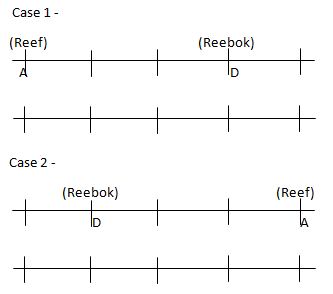 (ii)- G likes PF Flyers and sits one of the extreme end of the row. J sits third to the left of F. J neither likes Moon boot nor Adidas (from all these conditions case1 will be eliminated and in case2- G sits at the extreme left end of the row then J sits to its immediate right and F at the right end of the row). The one who likes Moon boot sits diagonally opposite to the one who likes Adidas. Now in case2, there will be two possible cases, case-2(a) and case2 (b); as shown below: Case 2(a)
 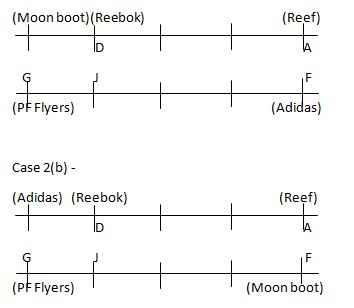 (iii)- H is not an immediate neighbour of the one who likes Moon boot. Only two persons sit between the one who likes Moon boot and the one who likes Kangaroos. The one who likes Kangaroos is not an immediate neighbour of A (from this case2 (a) will be eliminated). E sits third to the right of the one who likes Starbury (E likes Adidas is fixed). The one who likes Heelys faces north (thus it is fixed in row-2). Now, the one who likes Nike faces the person who likes Volley. The one who likes Volley faces the one who sits immediate right of the one who likes Starbury (from this it is clear that the one who likes Starbury faces the one who likes Heelys). K doesn’t face B (thus K faces C). The final arrangement will be: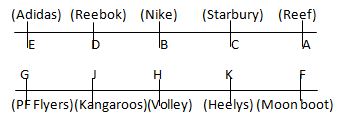
More Seating Arrangement Questions
- Who sits second to the right of W?
- Who lives in Assam?
- Who lives on the floor immediately above Kabir?
- What is the position of R with respect to her grandmother?
- Who among the following person sits opposite to F?
- Who sits adjacent to W?
- Six persons A, B, C, D E and F are sitting around a circle facing the centre. A sits third to the left of E. B is not an immediate neighbour of A. Only one...
- How many persons sits between E and B when counted anticlockwise from E?
- Seven persons A, B, C, D, E, F and G sit around a circular table. All of them face away from the centre. G sits second to the right of F. Only two persons ...
- How many persons sit in the row?
Relevant for Exams:
Hey! Ask a query
Please enter email id
The email must be a valid email address.
Please enter Mobile Number
Please enter valid Mobile Number
Please enter your Doubt

Think You're Ready for RBI Grade B?
RBI Grade B 2026 Phase 1 Memory Based Paper
- 200 Questions with Detailed Solutions
- Section-wise Coverage (GA, English, Quant & Reasoning)