
Question
Four of the following five are alike in the certain way based on their seating positions and so form a group. Which is the one that does not belong to that group?
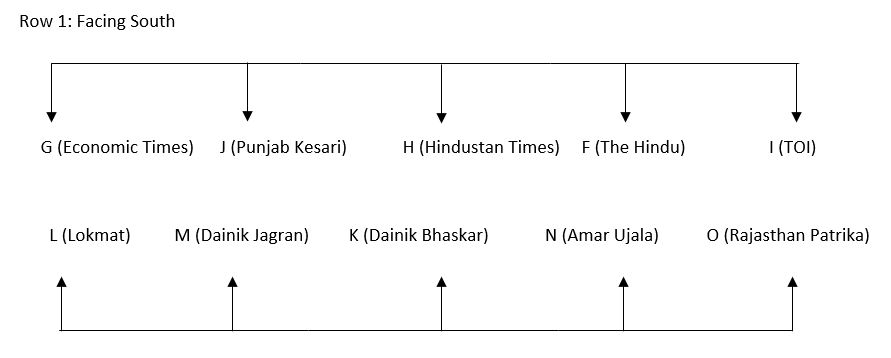
Study the following information carefully and answer the questions given below: Ten persons are sitting in two parallel rows containing five persons each, in such a way that there is an equal distance between adjacent persons. In row 1, F, G, H, I and J are seated and all of them are facing south. In row 2, K, L, M,N and O are seated and all of them are facing north. Therefore, in the given seating arrangement, each member seated in a row faces another member of the other row. Moreover, each of them reads different newspaper, viz. TOI, Hindustan Times, Economic Times, Dainik Jagran, Punjab Kesari, Amar Ujala, The Hindu, Dainik Bhaskar, Lokmat and Rajasthan Patrika, but not necessarily in the same order. Only two persons sit between J and the one who reads TOI, who sits at an extreme end. K, who sits in the middle of the row, is not an immediate neighbour of L, who does not read Rajasthan Patrika. O sit at an extreme end. J, who reads Punjab Kesari, sits on the immediate right of the one who reads Hindustan Times and J faces the immediate neighbour of
L. G does not sit at the extreme left end of his row. K does not read Lokmat. Only one person sits between H and I, I reads TOI. N reads Amar Ujala and is an immediate neighbour of the one who reads Rajasthan Patrika and doesn’t face the person who reads Economic Times. M, who reads Dainik Jagran, is an immediate neighbour of the one who reads Lokmat, who is facing an immediate neighbour of the one who reads Punjab Kesari. Only two persons sit between the one who reads The Hindu and the one who reads Economic Times. G does not read The Hindu. O who does not read Dainik Bhaskar.
More Seating Arrangement Questions
- Who is to the immediate right of Y?
- Four of the five pairs are related to each other in some way and thus form a group, then which of the following pairs is odd among all five?
- What is the position of I with respect to N?
- Eight people are sitting around a circular table on a wooden table. R is sitting between M and B. B is sitting third to the right of P. A sits between P an...
- How N is related to T?
- Five teachers, L, M, N, O and P, are sitting in a straight line facing towards north. P is between L and O. N is second to the right of O. L is to the imme...
- If all the persons are arranged in alphabetical order from I in a clockwise direction, then how many persons remain unchanged in their position(Excluding I...
- In a certain way, D is related to R, P is related to C, in the same way S is related to who among them following person?
- Six friends are sitting in a circle and are facing the centre. R, C and P are females. V, M and A are males. M is between V and A, C is between P and R. V ...
- How many persons are sitting between D and C when counted from the left of D?
Hey! Ask a query
Please enter email id
The email must be a valid email address.
Please enter Mobile Number
Please enter valid Mobile Number
Please enter your Doubt
