


Question
What is the position of C with respect to the one who sits to the immediate right of Z?
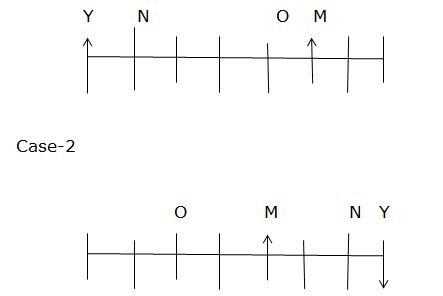 Only three persons sit between M and Z. Z is not facing the same direction as Y. C sits third to the right of B. Both C and B are facing the same direction. A sits second to the right of O. Both the immediate neighbors of M face opposite directions. Both O and N face the same direction as A. Hence, case 1 gets eliminated.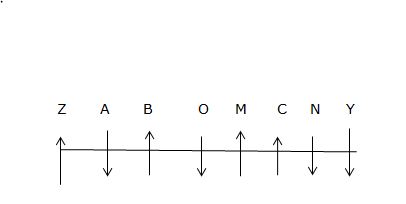
More Reasoning Miscellaneous Questions
- How many persons goes between A and G?
- If √256 ÷ √x = 2√2, then detemine the value of √x.
- A, B, C, D and E are working in a firm each earning a different amount. B earns more than D, who is not the least earner. C earns less than only A but more...
- If the consonants of the following words are arranged first, followed by the vowels as per the English alphabetical order and then the consonants are chang...
- Select the option which represents the correct arrangement when the given words are arranged in the order in which they appear in an English dictionary. 1-...
- How many seats are there in the row?
- Find the simplified value of the given expression:
- Which of the following statement is correct?
- Five words are given in the options and taking four letters of each of the words as specified, different words can be obtained and one of them is not an En...
- What is the shortcut key for 'Copy' in Windows?
Hey! Ask a query
Please enter email id
The email must be a valid email address.
Please enter Mobile Number
Please enter valid Mobile Number
Please enter your Doubt

Think You're Ready for RBI Grade B?
RBI Grade B 2026 Phase 1 Memory Based Paper
- 200 Questions with Detailed Solutions
- Section-wise Coverage (GA, English, Quant & Reasoning)