


Question
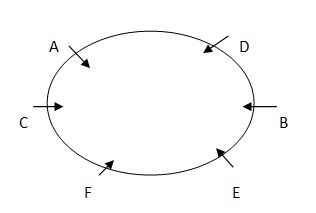
A question is given, followed by two statements labelled I and II. Identify which of the statements is/are sufficient to answer the question. Question: A, B, C, D, E and F are sitting around a circular table. Each of them faces either the centre of the table or outside (i.e., opposite to the centre). In which direction is D facing? Statements: (
- I B sits second to the right of F and both are facing the centre. Only two people are sitting between A and E from the either sides. Both A and E are facing the same direction. A is not an immediate neighbor of B. (I
- I C is facing the opposite direction of B. D is sitting to the second left of C.
More Previous year papers Questions
- In each of the following questions, a specific pattern such as reversal or rearrangement has been applied to the first word to get the second. Apply the s...
- Question 2
- In the question below are given some statements followed by some conclusions. You have to take given statements to be true even if they seem to be at varia...
- If ROME is coded as 6821, PARIS is coded as 94657 and SHAME is coded as 73421, what will be the code for MISHAP?
- Read the direction carefully and answer the following question. Eva is ranked 3rd from the top, while Vicky is ranked 7th from the bottom. If there are 12 ...
- A group of seven students A, B, C, D, E, F and G are going to form two terms. Each team can have a maximum of four members. A and B cannot be in the same t...
- Select the set in which the numbers are related in the same way as are the numbers of the following sets. (NOTE: Operations should be performed on the whol...
- If all the letters appearing at the odd number positions in the English alphabet are removed, then what will come at the 9th place in the new alphabet seri...
- The sequence of folding a piece of paper and the manner in which the folded paper is cut is shown in the following figures. How would this paper look when ...
- In a certain code language, 'GATE' is written as 'JOFB' and 'IDLE' is written as 'JGID'. How will 'MILK' be written in that language?
Relevant for Exams:
Hey! Ask a query
Please enter email id
The email must be a valid email address.
Please enter Mobile Number
Please enter valid Mobile Number
Please enter your Doubt

Think You're Ready for RBI Grade B?
RBI Grade B 2026 Phase 1 Memory Based Paper
- 200 Questions with Detailed Solutions
- Section-wise Coverage (GA, English, Quant & Reasoning)