


Question
A question is given, followed by two statements numbered (
- I and (I
- I . You have to decide whether the data provided in the statements is sufficient to answer the question. Read both the statements and select the appropriate answer. Six boxes F, G, H, I, J and K are kept one above the another but not necessarily in the same order. The bottommost box is numbered as 1 st and the topmost box is numbered 6 th . Which box is kept at topmost position? Statements: (
- I G is kept three boxes above F. No box is kept below H. I is kept above K, which is kept above J. J is not kept at odd numbered position. (I
- I I is kept two boxes above F. J is kept just below F. F is kept at prime numbered position. K is kept three boxes above H.
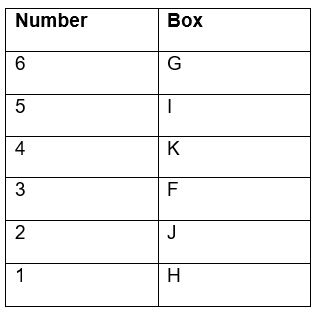 Clearly, G is kept at the topmost position. So, statement I alone is sufficient to answer the question. From statement II alone, I is kept two boxes above F. J is kept just below F. F is kept at prime numbered position. K is kept three boxes above H.
 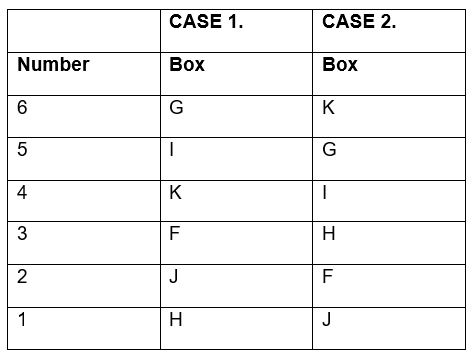 Either K or G is kept at the topmost position. So, statement II alone is not sufficient to answer the question. So, data given in statement I alone is sufficient to answer the question while date given in statement II is not.
More Data Sufficiency Questions
- Six persons R, S, T, U, V and W are sitting in a row facing north. Who among the following sits at the extreme left end?Statement I. W sits to the immediat...
- Among P, Q, R, S, T and U, each has a different height. Who is the smallest? I. P is not the shortest. R is taller than S but shorter than P. II. Q is shor...
- Seven persons A, B, C, D, E, F and G are attending the interview on six different days starting from Monday to Sunday in a week but not necessarily in the ...
- Seven persons M, N, O, Q, R, S and T sit in a straight row facing north direction. Who sits 2nd from the left end? Statement I: O sits 2nd to the left of R...
- Which date in the month of July is definitely Harish mother’s birthday? I. Harish correctly remembers that his mother’s birthday is after 15th but before ...
- Preeti is in which direction with respect to Suhail? I. Mohit is to the west of Tarun, who is to the north of Suhail. Preeti is to the north of Mohit. II...
- The question given below consists of two statements numbered I and II given below it. You have to decide whether the data provided in the statements are su...
- What is Joy’s position in boys when counting from bottom? I. There are 80 students in the class and Joy is ranked fifteenth from the top, and there are 6 ...
- Eight persons K, L , M, N, O, P, Q and R are seated around a circular table facing the centre. Who is opposite P? I. P sits second to the left of N, who i...
- The question given below consists of three statements numbered I, II and III given below it. You have to decide whether the data provided in the statements...
Relevant for Exams:
Hey! Ask a query
Please enter email id
The email must be a valid email address.
Please enter Mobile Number
Please enter valid Mobile Number
Please enter your Doubt

Think You're Ready for RBI Grade B?
RBI Grade B 2026 Phase 1 Memory Based Paper
- 200 Questions with Detailed Solutions
- Section-wise Coverage (GA, English, Quant & Reasoning)